
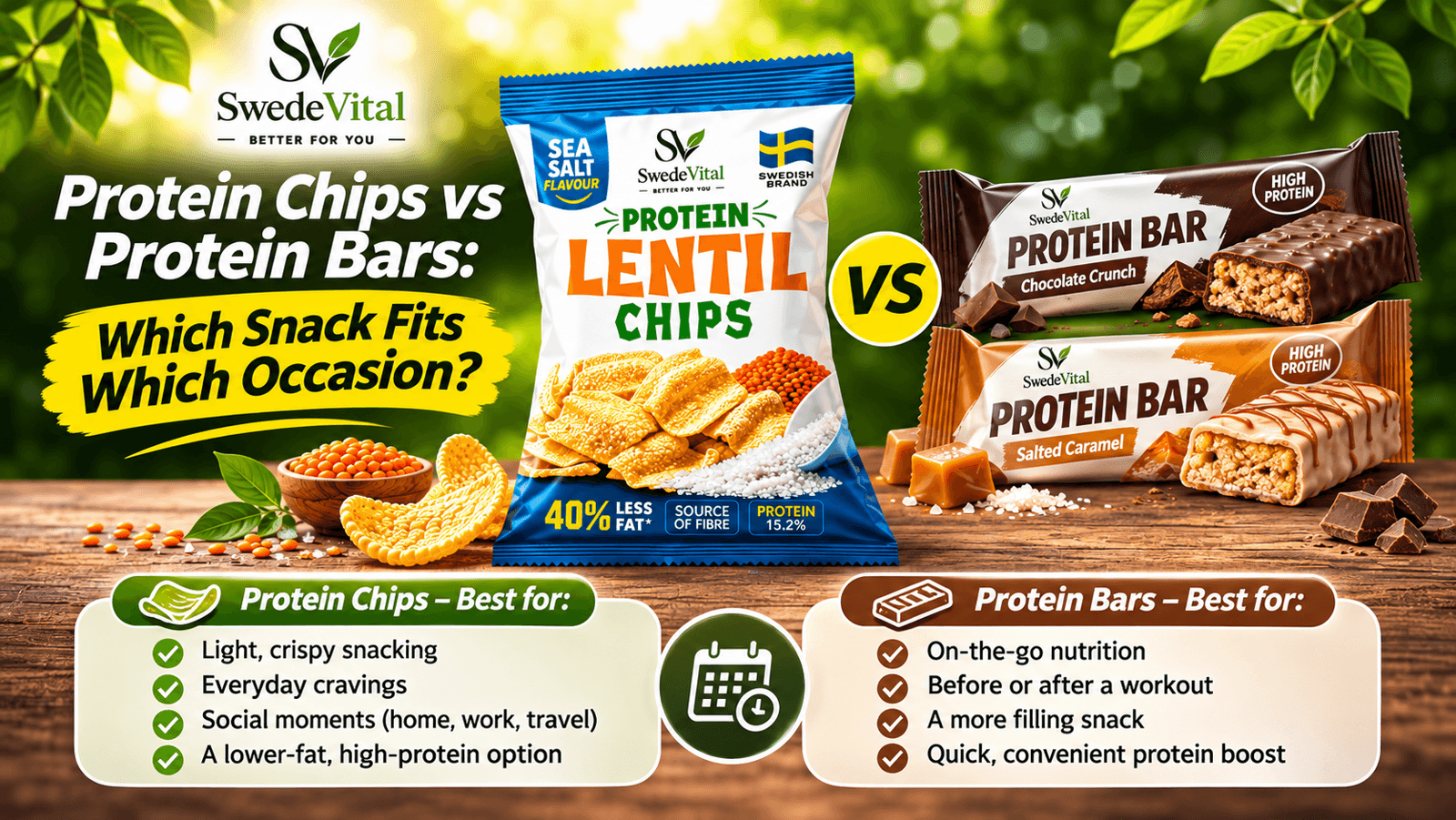
Protein Chips vs Protein Bars: Which Snack Fits Which Occasion?

SwedeVital Authority Engine™
SwedeVital
In short
Protein chips are ideal for savoury, crunchy moments like desk snacks, while protein bars excel as portable, meal‑bridging options for on‑the‑go and gym use.
- Match protein chips to savoury, crunchy occasions and protein bars to portable, meal‑bridging moments for optimal retail placement.
Protein chips vs protein bars is rarely a true either/or decision for a category buyer — it is a question of matching format to occasion. Protein chips win the savoury, crunchy, share-and-graze and desk-lunch moments where shoppers want an alternative to standard crisps. Protein bars own the portable, meal-bridging, gym-bag and travel moments where satiety and convenience matter most. Stocked together, they cover complementary shopper jobs and rarely cannibalise one another.
For retail buyers, wholesalers and private-label partners deciding what to list, the useful lens is not “which is better” but “which occasion, which shopper, which fixture.” This guide breaks down the trade-offs, the merchandising logic, and a practical stocking checklist so you can build a protein-snacking range that sells through rather than sits.
Protein chips vs protein bars: a buyer’s snapshot
Both formats ride the same structural tailwind: shoppers are actively trading up from purely indulgent snacks toward options that carry a functional benefit, and protein is the most recognised of those benefits. But the two formats express that benefit in very different ways.
Protein bars are a format shoppers already understand. They are shelf-stable, highly portable, and read instantly as a between-meals or meal-adjacent option. Their weakness is category fatigue: the segment is crowded and heavily discount-anchored.
Protein chips are the disruptor format. They borrow the ritual and mouthfeel of crisps while offering a higher-protein, often lower-fat proposition. They tend to attract a shopper who wants permission to snack savoury, not a nutrition project. Their weakness is that they are newer, so education and placement do more of the work.
A simple rule of thumb: bars replace a meal or a moment; chips replace a habit. Buyers who internalise that difference merchandise the two very differently.
Reading the occasion: where each format earns its place
Occasion mapping is the single most useful exercise a buyer can run before listing. Snacking is driven by moments, not by nutritional theory, and each format has moments it wins cleanly.
The savoury-crunch occasion
This is the mid-afternoon desk slump, the “something with my lunch” add-on, the evening graze in front of a screen. The shopper wants texture, salt and a satisfying crunch — the sensory profile of crisps — without feeling they have derailed the day. Protein chips are built for this moment. They fit food-to-go fixtures, meal-deal add-ons, and impulse zones near tills and coffee bars. Because they are savoury, they also reach a shopper who finds sweet protein bars off-putting.
The meal-bridge and on-the-go occasion
This is the commuter skipping breakfast, the parent between school runs, the traveller in an airport. The job is to bridge to the next meal with minimal fuss and maximum portability. Protein bars are hard to beat here: no crumbs, a self-contained single portion, and a nutrition panel that reassures. Place them at transport hubs, gym-adjacent fixtures, checkout and forecourt.
The training and recovery occasion
Active shoppers and gym-goers reach for protein around workouts. Here bars and chips both play a role, but they sit alongside — not against — protein powder, which remains the reference format for concentrated protein per serving. Powder is the daily staple for committed trainers; bars and chips are the no-mixing, eat-anywhere companions for the same shopper. Listing all three within one shopper mission (train and recover) can drive multiple units into a single basket.
Format trade-offs that shape sell-through
Beneath the occasion lens sit hard format trade-offs. These determine margin, waste and repeat purchase, so they deserve deliberate weighing.
- Satiety and positioning: Bars generally position as a fuller, meal-adjacent portion; chips position as a lighter, permissible graze. Neither should be sold as a health fix — the honest claim is that they help shoppers swap up from a less considered option.
- Texture and repeat purchase: Crunch has strong repeat-purchase pull because it scratches the same itch as crisps. Bar repeat purchase hinges heavily on taste and mouthfeel; a chalky or overly dense bar rarely earns a second buy.
- Ingredient transparency: Both formats face growing scrutiny of sweeteners, protein sources and additives. Clean, readable labels increasingly out-perform higher-protein products carrying long ingredient lists.
- Shelf life and robustness: Bars tend to be forgiving on shelf life and handling. Chips need protection from crushing and benefit from packaging that visibly signals crunch and freshness.
- Price architecture: Bars sit in a discount-heavy, price-anchored segment. Chips, as a newer format, tend to hold price better but need trial-driving mechanics to earn the first purchase.
Merchandising protein chips vs protein bars in your category
Where you place each format matters as much as whether you list it at all. The instinct to file both under “sports nutrition” leaves money on the table, because most shoppers buy protein snacks on general-snacking missions, not specialist ones.
Practical placement logic:
- Dual-siting beats single-siting. Keep a core range in the health or sports bay for the mission shopper, and cross-merchandise into crisps, meal-deal, checkout and food-to-go for the impulse shopper.
- Let chips sit near crisps. The comparison most shoppers make is chips-versus-crisps, not chips-versus-bars. Placing protein chips beside standard crisps captures the trade-up decision at the point it is made.
- Let bars sit near the exit and the go. Meal-bridge purchases are made on the move; forecourt, till and transport-adjacent fixtures convert best.
- Signpost the benefit simply. “High in protein,” “no artificial sweeteners” or “savoury crunch” shelf-talkers do more than a protein grammage most shoppers cannot contextualise.
Where protein powder fits the range logic
It is worth naming the elephant in the aisle: search demand for protein powder dwarfs that for either snack format, and many shoppers who buy powder are exactly the audience for premium protein snacks. Powder is the concentrated, cost-per-gram-efficient staple; snacks are the convenience layer on top. For a buyer, that means protein chips and protein bars are not competing with powder for the same job — they are the grab-and-go extension of the same shopper’s protein habit. A range that offers powder for the routine and snacks for the moments captures more of that shopper’s spend than any single format alone.
Private-label and sourcing considerations
For distributors and private-label partners, the format choice interacts with sourcing risk and differentiation.
- Differentiation: The bar segment is crowded, so private-label bars must differentiate on taste, ingredient story or format — bites and mini-formats can open new occasions. Protein chips are less saturated, giving an own-brand more room to stand out.
- Format range: A credible supplier should let you build across occasions — for example, protein lentil chips and protein bites for savoury and graze moments, and protein bars for the meal-bridge — so one relationship covers multiple fixtures.
- Claims discipline: Whatever the format, claims must be evidence-led and compliant. Position benefits honestly (“a source of protein,” “may support a higher-protein diet”) rather than promising outcomes.
- Supply reliability: Newer formats can carry more supply volatility. Confirm consistency, lead times and specification stability before committing shelf space.
SwedeVital’s range spans both sides of this decision — protein lentil chips, protein bites and natural bites for the savoury-graze occasions, and protein bars for the meal-bridge — which lets a buyer test complementary occasions without splitting the relationship across multiple suppliers.
A category manager’s stocking checklist
Before you finalise a protein-snacking listing, run this checklist:
- Occasion coverage: Have I stocked for both the savoury-graze and the on-the-go meal-bridge, rather than doubling down on one?
- Fixture logic: Are chips cross-sited near crisps and bars near the go, instead of both buried in sports nutrition?
- Range depth: Do I have a clear hero SKU per occasion before adding line extensions?
- Label clarity: Do the products read cleanly on sweeteners and protein source?
- Trial mechanics: For the newer chip format, do I have a way to drive first purchase — siting, shelf-talkers, meal-deal inclusion?
- Margin and price hold: Am I over-anchored to the discount-driven bar segment, or balancing it with better-holding formats?
Frequently asked questions
Are protein chips healthier than protein bars?
Neither format is categorically “healthier” — it depends on the specific recipe. Protein chips often position as lower-sugar, savoury alternatives to crisps, while bars vary widely from clean, minimal-ingredient options to more confectionery-like ones. For a buyer, the more useful question is which format helps the shopper trade up from a less considered choice, and which reads cleanly on its label.
Do protein chips and protein bars compete with protein powder?
Not directly. Protein powder is the concentrated daily staple for routine protein intake, while chips and bars serve convenience and snacking moments. The same shopper frequently buys all three, so ranging them together tends to grow basket value rather than split it.
Which sells better, protein chips or protein bars?
It varies by store format and shopper base. Bars have broader familiarity and a proven on-the-go occasion; chips are a faster-growing, less saturated format with strong repeat-purchase pull from their crisp-like crunch. The strongest ranges stock both and let occasion, not preference, decide the split.
Where should I merchandise protein chips in store?
Cross-site protein chips near standard crisps and in food-to-go and meal-deal fixtures, where the trade-up decision is actually made, while keeping a core presence in the health or sports bay for mission shoppers.
Can one supplier provide both protein chips and bars for private label?
A supplier with a broad better-for-you range can cover both occasions — savoury chips and bites plus meal-bridge bars — under a single relationship. Confirm specification stability, lead times and claims compliance before committing shelf space.
How much protein should a protein snack contain?
There is no single required figure, and buyers should avoid implying one on shelf. Focus instead on honest labelling and clean formulation; a credible “source of protein” or “high in protein” claim, correctly substantiated, matters more to shoppers than a headline number they cannot contextualise.
Related reading
Frequently asked questions
What occasions are best for protein chips?+
Protein chips excel in savoury‑crunch moments such as mid‑afternoon desk slumps, lunch add‑ons, and evening grazing in front of screens.
When should I stock protein bars?+
Protein bars are best for portable, meal‑bridging occasions like commuting, travel, gym trips, and parent‑between‑school runs.
How do I place protein chips in the store?+
Place protein chips near standard crisps, in food‑to‑go fixtures, meal‑deal add‑ons, and impulse zones near tills and coffee bars.
Where should protein bars be displayed?+
Position protein bars at transport hubs, gym‑adjacent fixtures, checkout, and forecourt to capture on‑the‑go shoppers.
What are the main trade‑offs between the two formats?+
Bars offer fuller, meal‑adjacent portions with higher margin but face category fatigue; chips provide lighter, crunchy snacking with better price resilience but need education and protection from crushing.
See the full SwedeVital range
Every line, every format, and what it takes to stock them — sent to you now, before we open for orders on 1 January 2027.
Written by
SwedeVital Authority Engine™
Last updated
6 November 2026