
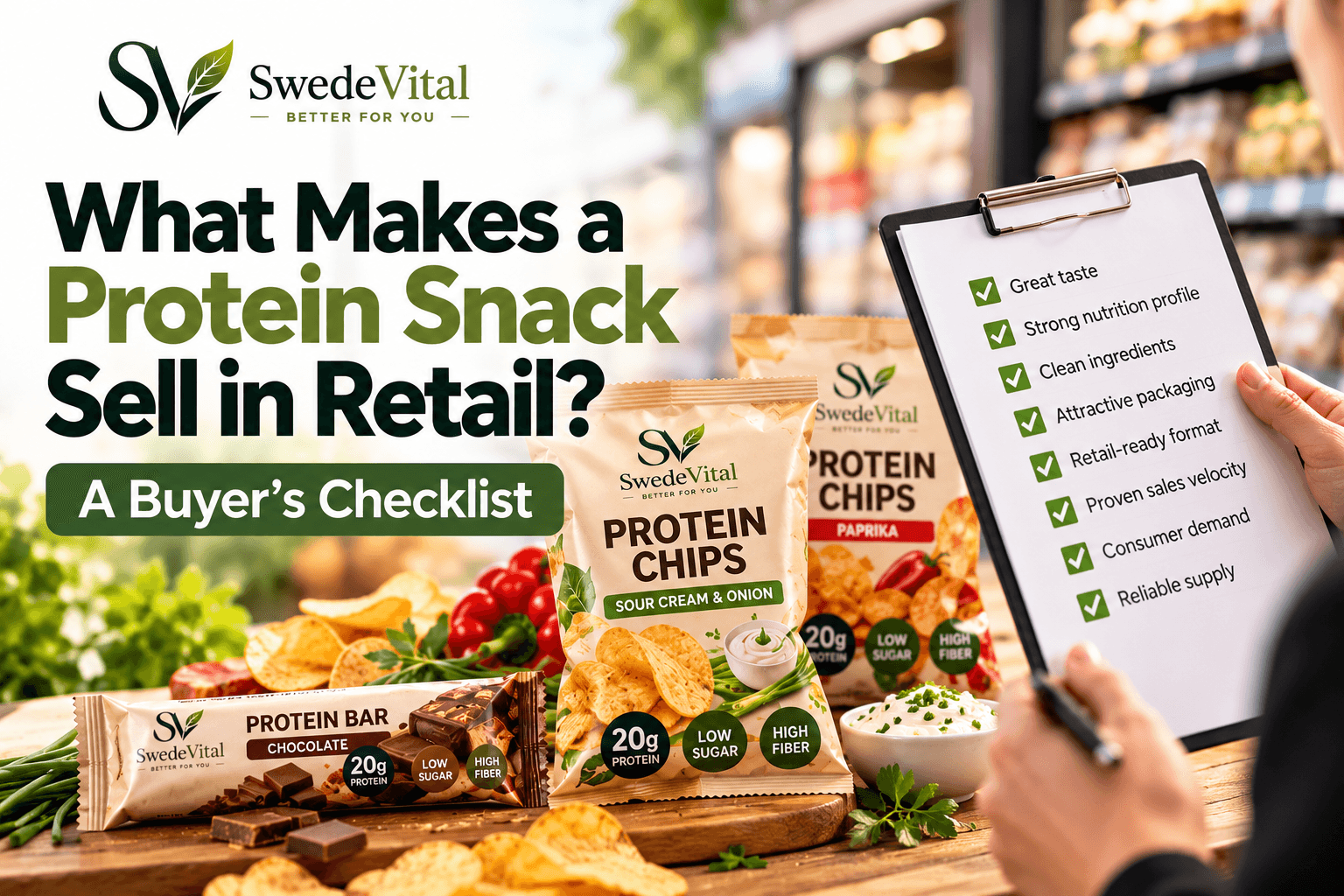
What Makes a Protein Snack Sell in Retail? A Buyer's Checklist

SwedeVital Authority Engine™
SwedeVital
In short
To sell protein snacks in retail, buyers must ensure the product has a credible protein claim, fits a specific eating occasion with the right format, offers clear packaging, delivers taste and repeatability, and has reliable supply and sensible pricing.
- Protein snacks sell when buyers verify credible claims, match format to occasion, ensure clear packaging, taste, repeatability, and reliable supply at a sensible price.
A protein snack earns its place on shelf when three things line up at once: a protein claim buyers can trust, a format and price that match a real eating occasion, and packaging that communicates the benefit in under three seconds. For anyone building a protein snacks retail range — category managers, buyers, independent store owners and distributors — the winners are rarely the products with the highest protein number on the front. They are the ones that turn a shopper's intent into a repeat purchase. This buyer's checklist breaks down what actually drives sell-through, where the trade-offs sit, and which questions to put to a supplier before you commit valuable shelf space.
Why the protein snacks retail category keeps growing
Protein has moved from a bodybuilding niche into everyday grocery behaviour. The same shopper who searches for protein powder, buys ready-to-drink protein shakes, or scans packs for high protein foods is also the shopper reaching for something portable at 3pm. That is the demand signal a buyer should read: protein is now a permission-to-eat cue that reframes a snack as a functional choice rather than an indulgence. When a consumer types healthy snacks into a search bar, a growing share expect protein to be part of the answer.
For the category, that means two things. First, protein snacks compete less with confectionery and more with the whole "better-for-you" set — nuts, yoghurt, bars and bites. Second, the halo from the wider protein aisle (powders, shakes, high-protein dairy) does the education for you; the shopper already believes protein is valuable, so the snack only has to prove it delivers credibly and tastes good enough to buy again. That shift in belief is what changes the buyer's job: you are no longer persuading shoppers that protein matters, you are helping them choose between products that all claim it. Trust and clarity, not the raw protein number, become the deciding factors.
The buyer's checklist for protein snacks retail
Before a single case enters a planogram, run each candidate product through the same filter. A disciplined checklist stops "interesting" products from crowding out sellable ones.
- Credible protein claim. Is the protein content high enough to justify the positioning, and does the label back it under the relevant food-labelling rules? A vague "with protein" flash rarely converts.
- Clear eating occasion. Can you name exactly when and why a shopper eats this — gym bag, lunchbox, desk drawer, post-workout? Occasion drives format, and format drives velocity.
- Shelf-ready packaging. Does the front of pack land the benefit in three seconds, and does the pack physically merchandise well (hanging, stacking, facings)?
- Taste and repeat. Trial is easy; repeat is the business. Have you tasted it blind against the incumbents?
- Ingredient story. Clean, recognisable ingredients and a short list travel further with modern shoppers than a long deck of additives.
- Price architecture. Does the retail price sit sensibly against adjacent products, and does the margin work at that price?
- Supply reliability. Realistic lead times, sensible minimum order quantities (MOQs), consistent quality, and documentation ready for audit.
Score each product across these seven points. Anything that fails the first three — claim, occasion, packaging — is a distraction no margin can rescue.
Reading the protein claim like a buyer, not a fan
The number on the front of pack is where most stocking decisions go wrong. A pack can be technically accurate and still mislead a shopper about how much protein a serving really delivers, so read the claim the way a regulator would.
In European retail, "source of protein" and "high in protein" are regulated nutrition claims tied to the proportion of energy the product derives from protein — not marketing adjectives a brand can apply freely. Ask the supplier which threshold the product meets and to show the calculation. Then check the practical question your shopper is really asking: how much protein do I get per serving I would actually eat? A chip pack quoting protein per 100g can look impressive while a single 30g portion delivers far less. Buyers who normalise every candidate to a realistic serving avoid stocking products that over-promise and under-deliver, which is exactly what erodes repeat rate.
Non-committal, evidence-led messaging protects you too. Claims that protein "may support satiety and muscle maintenance as part of a balanced diet" reflect what research generally supports; guarantees of specific outcomes invite complaints and compliance risk.
Format, occasion and price: matching the product to the moment
Format is where a protein range either specialises or blurs into sameness. Each format answers a different occasion, and the strongest planograms cover a spread rather than five variations of one thing. A buyer who maps candidates onto occasions first, and formats second, avoids the common trap of listing three bars that all serve the same mid-afternoon moment while leaving grazing and savoury gaps unfilled.
Bars, chips and bites each own a moment
Protein bars remain the anchor of the category — a genuine transactional search magnet and the format shoppers reach for as a meal bridge or post-workout fix. But bar fatigue is real, and this is where savoury and lighter formats earn their listing. Protein lentil chips answer the "I want to snack, not eat a supplement" moment, competing directly with crisps while carrying a protein story. Protein bites and natural bites suit grazing, lunchboxes and shoppers who want a smaller, less "engineered" experience. Ranging across bar, savoury and bite formats lets one fixture serve several occasions instead of cannibalising itself.
Price against the neighbour, not the category
Shoppers judge price against whatever sits beside the product, not against an abstract category average. A protein bar is measured against other bars and against a chocolate bar; a protein chip against crisps. Set the retail price so the premium reads as justified by the protein benefit, then confirm the margin still works. If a product only works at a price the adjacent set won't support, it is a mismatch regardless of how good it tastes.
Margin, MOQ and the private-label decision
Once a product clears the sell-through filters, the commercial terms decide whether it is worth the slot. Treat margin as a range across the range, not a single hurdle: a hero SKU can carry a lower margin if it drives traffic, while secondary lines should defend blended profitability.
Minimum order quantities deserve equal scrutiny. A low unit cost is meaningless if the MOQ forces you to hold months of stock in a category where freshness and rotation matter. Ask for the real numbers — MOQ per SKU, lead time, shelf life on arrival, and reorder minimums — and model the cash you tie up, not just the headline price.
Private label is the higher-commitment path and, done well, the higher-reward one. It lets a retailer own the brand relationship and margin, differentiate from competitors, and shape the recipe and pack. The trade-off is volume commitment, longer development timelines and full ownership of quality and compliance. Manufacturers who offer both branded supply and private-label development — as SwedeVital does across its plant-based protein snack and functional-wellness lines — give a buyer room to start with proven branded lines and graduate to private label once the occasion is validated.
Merchandising for velocity once it is on shelf
A well-chosen product still fails if it is merchandised badly. Sell-through is a function of visibility as much as of the product itself.
- Block by benefit. Group protein snacks so the shopper reads "protein" as a destination, rather than scattering them through confectionery where they disappear.
- Secondary siting. Place a facing near the chilled protein shakes, the sports aisle, or grab-and-go by the till — wherever protein intent is already high.
- Give heroes the facings. Resist spreading facings evenly. Reward the proven sellers and let weak SKUs earn their place or exit.
- Trial mechanics. Because repeat is the whole game, structured trial — sampling, intro pricing, multi-buy — pays back faster in protein than in most impulse categories.
Review velocity by SKU on a fixed cadence and delist the tail without sentiment. A tight, high-rotating set beats a broad, dusty one every time.
Vetting the supplier before you list
The product is only as reliable as the partner behind it. Put these questions to any supplier of protein snacks before you commit:
- Can you evidence every nutrition and health claim, and provide specifications and certificates for audit?
- What are true lead times, MOQs and shelf life on delivery — and how consistent is batch-to-batch quality?
- Do you supply branded, private label, or both, and what is the development path between them?
- How do you handle allergens, traceability and recall procedures?
- What marketing and merchandising support — imagery, sampling, planogram guidance — comes with the range?
A supplier who answers these crisply, with documents rather than adjectives, is one you can build a category on. SwedeVital manufactures across both a plant-based protein snack range — protein lentil chips, protein bites, natural bites and protein bars — and a functional-wellness line, which lets a buyer consolidate suppliers while still ranging for several distinct occasions.
The bottom line for buyers
The products that win in the protein snacks retail aisle are not the loudest on protein content; they are the ones that pair a credible, well-labelled claim with a clearly owned eating occasion, a price the neighbouring set supports, and a supplier who can deliver reliably. Run every candidate through the checklist, taste before you list, merchandise for visibility, and review velocity without sentiment. Do that consistently and the category compounds — each disciplined listing raises the average and trains shoppers to treat your fixture as the place protein lives.
Related reading
- protein chips retail growth
- better‑for‑you snack strategy
- distributor buying guide
- evaluate new protein brands
- margin versus velocity
Sources
Frequently asked questions
What makes a protein claim credible for buyers?+
A credible claim meets regulatory thresholds for "high in protein" or "source of protein" and is backed by calculations showing protein per realistic serving.
How does format affect sell‑through?+
Different formats target distinct occasions—bars for post‑workout, chips for grazing, bites for lunchboxes—allowing a single fixture to serve multiple moments.
Why is packaging important?+
Packaging must communicate the benefit in under three seconds, fit shelf merchandising (hanging, stacking), and be visually appealing to drive impulse buys.
What role does price play?+
Buyers judge price against adjacent products, not the category average, so the price must be competitive with similar formats while maintaining margin.
How can buyers ensure supply reliability?+
Check realistic lead times, sensible MOQs, consistent quality, and audit‑ready documentation to avoid stockouts and quality issues.
See the full SwedeVital range
Every line, every format, and what it takes to stock them — sent to you now, before we open for orders on 1 January 2027.
Written by
SwedeVital Authority Engine™
Last updated
16 October 2026