
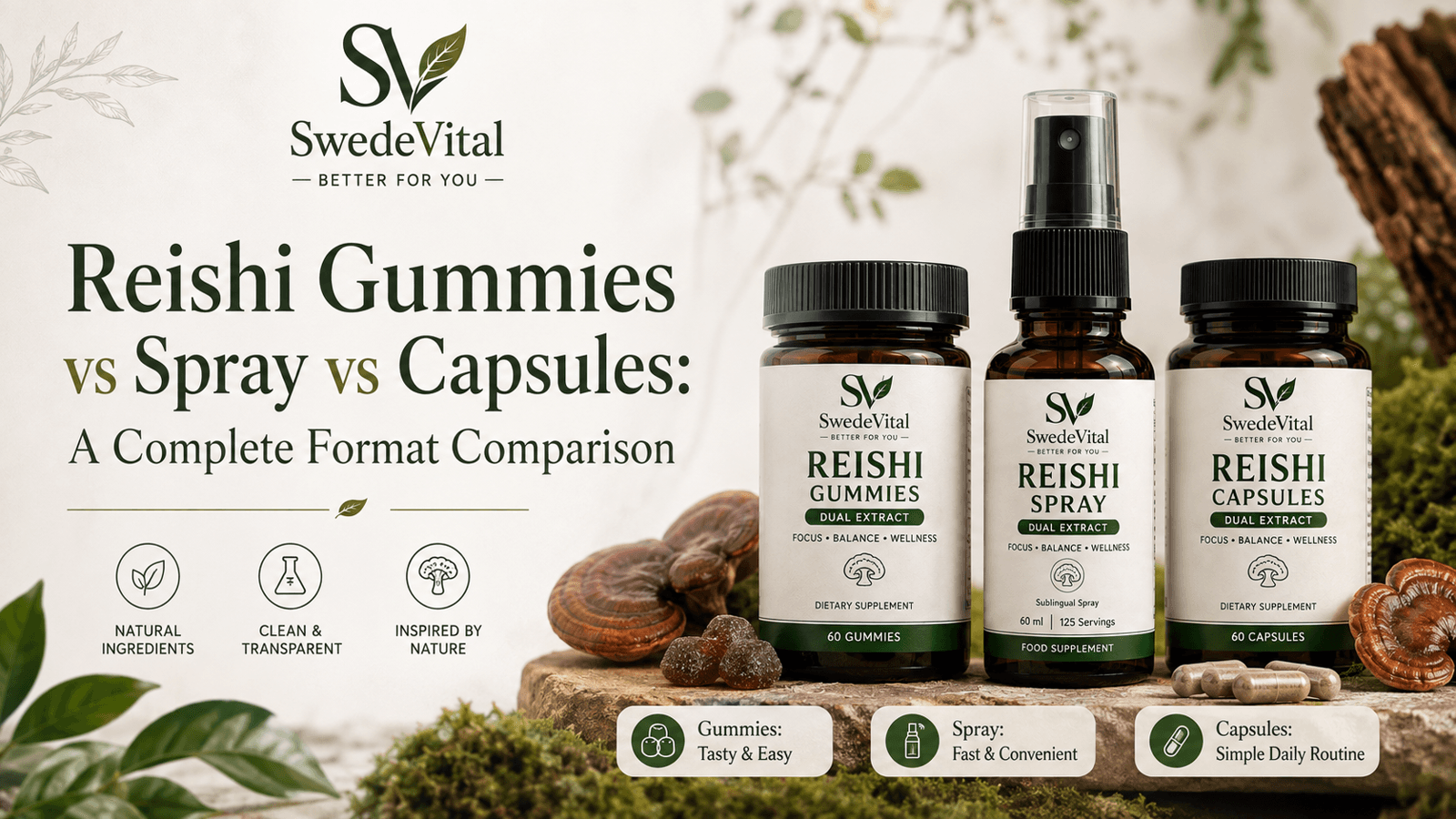
Reishi Gummies vs Spray vs Capsules: A Complete Format Comparison

SwedeVital Authority Engine™
SwedeVital
In short
Capsules deliver the most concentrated Reishi extract per serving and have a clean label, gummies offer flavor and higher compliance, while dual-extract sprays provide portable, adjustable dosing. The best choice is the format you’ll actually take daily.
- Capsules give the highest potency, gummies win on taste and consistency, and sprays offer portability and flexible dosing—pick the one you’ll use every day.
When comparing Reishi gummies vs capsules, there is no single "best" format — each trades potency, taste, convenience and cost differently. Capsules typically pack the most concentrated extract per serving with no added sugar; gummies win on flavour and everyday habit-forming compliance; and dual-extract sprays offer fast, water-free, adjustable dosing. The right pick depends on who is taking it, how often, and what your shoppers actually reach for. This guide compares all three formats so buyers and consumers can choose with confidence.
Reishi gummies vs capsules: the quick verdict
Reishi (Ganoderma lucidum) is one of the most researched functional mushrooms, and it now reaches shelves in several delivery formats. If you want the headline before the detail: choose capsules for the highest extract concentration and the cleanest label, choose gummies for taste and consistency of use, and choose a dual-extract spray for portability and flexible dosing. In this specific comparison, capsules usually deliver more milligrams of extract per serving, while gummies tend to deliver a more enjoyable daily ritual that people are less likely to skip. Sprays split the difference, prioritising convenience and control over raw dose.
The best format is the one a person will actually take every day. Consistency, not a marginal difference in milligrams, is what makes a supplement a routine rather than a drawer decoration.
What Reishi is — and why the format matters
Reishi has been used in East Asian herbal traditions for centuries and is traditionally associated with calm, resilience and general wellbeing. In modern products, the compounds of interest are usually beta-glucans (polysaccharides that are water-soluble) and triterpenes (the bitter, alcohol-soluble compounds that give Reishi its distinctive character). Research suggests these compounds are the reason Reishi is studied for immune modulation, stress response and sleep, though results are still emerging and no format guarantees a specific health outcome.
Format matters because it influences three practical things: how much active extract you receive per serving, how the product tastes, and how likely someone is to take it consistently. It does not change the underlying botanical — but it does change the experience, and experience drives repeat use. A retailer weighing up a range should treat these three levers as the real decision, because they determine who buys, who comes back, and who quietly stops.
Do formats change how Reishi is absorbed?
This is where marketing often outruns the evidence. Claims that one delivery method is dramatically "more bioavailable" than another should be treated with caution unless a product can substantiate them. What can be said fairly is that liquids and gummies are already broken down and do not require a capsule shell to dissolve first, while capsules protect a precise, concentrated dose until it reaches the stomach. Research suggests that consistent intake of a quality extract over time matters more than small format-driven differences in absorption. For most shoppers, the format that gets taken daily will outperform a theoretically superior one that sits unused.
Extract quality is more important than format
Before comparing formats at all, buyers should look at the extract itself. Two questions matter most:
- Fruiting body or mycelium? Fruiting-body extracts are generally richer in the triterpenes associated with Reishi, whereas grain-grown mycelium products can carry significant starch. A quality label is transparent about which it uses.
- Dual-extracted or single? Because Reishi's actives split between water-soluble and alcohol-soluble compounds, a dual extraction (hot water plus alcohol) is designed to capture both. Single water extraction can miss the triterpenes.
A well-made gummy from a strong dual extract can outperform a capsule filled with low-grade powder. Format is a distant second to sourcing and extraction.
Reishi capsules: the concentrated standard
Capsules are the traditional workhorse of the supplement world, and for good reason. They allow a manufacturer to pack a high, precisely measured dose of extract into a small, tasteless, sugar-free serving.
Strengths:
- Highest concentration per serving — no room is taken up by sugar, water or flavouring, so more of the capsule is extract.
- Clean, minimal label — often just the extract and a plant-based or gelatine shell, which appeals to purist shoppers.
- No sugar and long shelf stability — a natural fit for keto, low-sugar and clinical-leaning ranges.
- Precise, repeatable dosing — easy to communicate a serving size on pack.
Trade-offs: capsules are the least pleasant format for people who dislike swallowing pills, they mask none of Reishi's earthy character if the shell is opened, and they can feel "clinical" rather than lifestyle-friendly. For children, older adults, or anyone with pill fatigue, capsules are often the first format abandoned.
Reishi gummies: where mushroom gummies win on habit
Mushroom gummies have driven much of the recent growth in functional mushrooms, and Reishi is a natural fit for the format. A gummy turns a supplement into something closer to a treat, which is precisely why compliance tends to be higher — people remember and enjoy taking them.
Strengths:
- Taste and enjoyment — flavouring masks Reishi's natural bitterness, widening appeal to first-time and younger buyers.
- Everyday compliance — an enjoyable format is taken more consistently, and consistency is what matters most.
- No water or swallowing required — helpful for pill-averse shoppers and on-the-go use.
- Strong shelf and gifting appeal — mushroom gummies photograph well and merchandise strongly in retail.
Trade-offs: gummies almost always deliver less extract per serving than capsules, because space is shared with pectin or gelatine, sweeteners and flavour. They usually contain some sugar or sugar alcohols, which may not suit low-sugar positioning, and heat-sensitive during shipping in warm climates. Buyers should always check the actual milligrams of Reishi extract per gummy rather than assume a serving matches a capsule.
Reishi dual-extract spray: flexible and fast
Sprays are the newest of the three formats and solve a specific problem: portability and adjustable dosing without water or swallowing. A dual-extract liquid is delivered as a fine mist, typically into the mouth, and absorbed as the liquid is swallowed.
Strengths:
- Adjustable dosing — users can take one spray or several, which suits people who like to titrate their own serving.
- Highly portable and discreet — a pocket-sized bottle with no water needed.
- Often built on a dual extract — liquids lend themselves naturally to combined water-and-alcohol extraction.
- No pill and minimal added sugar — a middle path between clinical capsules and indulgent gummies.
Trade-offs: sprays carry Reishi's taste more directly than a flavour-masked gummy, per-spray dosing can be less precise than a fixed capsule, and some formulations use alcohol or glycerine carriers that a minority of shoppers prefer to avoid. They are a strong "second bottle" for existing users rather than always the entry format.
Side-by-side: which format for which shopper
Rather than crowning a winner, match the format to the person and the occasion:
- Wants maximum potency, no sugar, clean label → capsules.
- Dislikes pills, values taste and routine → gummies.
- Travels, wants flexible dosing, hates swallowing → spray.
- Buying for children or older adults → gummies or spray over capsules.
- Keto, diabetic-conscious or clinical positioning → capsules or a low-sugar spray.
- First-time curious buyer → gummies, which convert newcomers most easily.
Many committed users end up owning two: a capsule for a reliable daily dose and a gummy or spray for convenience and enjoyment. That is a feature of a healthy category, not a contradiction. For category managers, this argues for stocking more than one format of the same trusted extract rather than betting a whole facing on a single delivery method. Gummies tend to recruit new, curious buyers into functional mushrooms; capsules retain the committed daily user; sprays add incremental purchases from travellers and existing fans. Together they widen the funnel instead of cannibalising it, and a shared extract keeps quality consistent across the shelf.
A buyer's checklist: choosing quality across every format
Whichever format you stock or buy, the same quality signals apply. Use this checklist before committing:
- Source — is it fruiting-body extract, and is that stated plainly on the label?
- Extraction — is it dual-extracted to capture both beta-glucans and triterpenes?
- Actives declared — does the label state milligrams of extract, and ideally beta-glucan content, rather than a vague "mushroom blend"?
- Serving honesty — for gummies and sprays, how many milligrams of real extract per serving, not per bottle?
- Added ingredients — sugar, sweeteners, carriers and allergens checked against your range's positioning?
- Compliance — are on-pack and marketing claims evidence-led and non-committal, in line with EU food-supplement rules?
- Testing — is there third-party or batch testing for heavy metals and contaminants?
SwedeVital produces its functional-wellness line — including Reishi as capsules, dual-extract sprays and gummies — so that retailers and private-label partners can offer the same trusted extract across formats and let shoppers choose the experience that fits their life. That breadth matters: the goal is not to sell one format but to keep a customer in the category, whichever delivery they prefer.
The bottom line on Reishi gummies vs capsules
In the Reishi gummies vs capsules comparison, capsules lead on concentration and clean labelling, gummies lead on taste and long-term adherence, and sprays sit between the two on flexibility. None is objectively superior — the meaningful variable is extract quality first, and real-world consistency second. Choose the format your shopper will keep reaching for, back it with a transparent dual extract, and keep every wellness claim honest and evidence-led.
Related reading
Frequently asked questions
Which Reishi format has the highest extract concentration?+
Capsules typically contain the most concentrated Reishi extract per serving, with no added sugar or flavoring.
Why are gummies popular for Reishi supplements?+
Gummies mask Reishi’s natural bitterness with flavor, making them more enjoyable and improving daily compliance.
Do sprays offer better absorption than capsules?+
There’s no clear evidence that sprays are more bioavailable; absorption differences are minimal compared to consistent intake of a quality extract.
What should I look for in the extract itself?+
Choose products with dual extraction (hot water + alcohol) and fruiting-body extracts for higher triterpene content.
Is sugar a concern in Reishi gummies?+
Many gummies contain sugar or sugar alcohols, which may not suit low-sugar or keto diets, so check the label if that matters to you.
See the full SwedeVital range
Every line, every format, and what it takes to stock them — sent to you now, before we open for orders on 1 January 2027.
Written by
SwedeVital Authority Engine™
Last updated
31 August 2026