
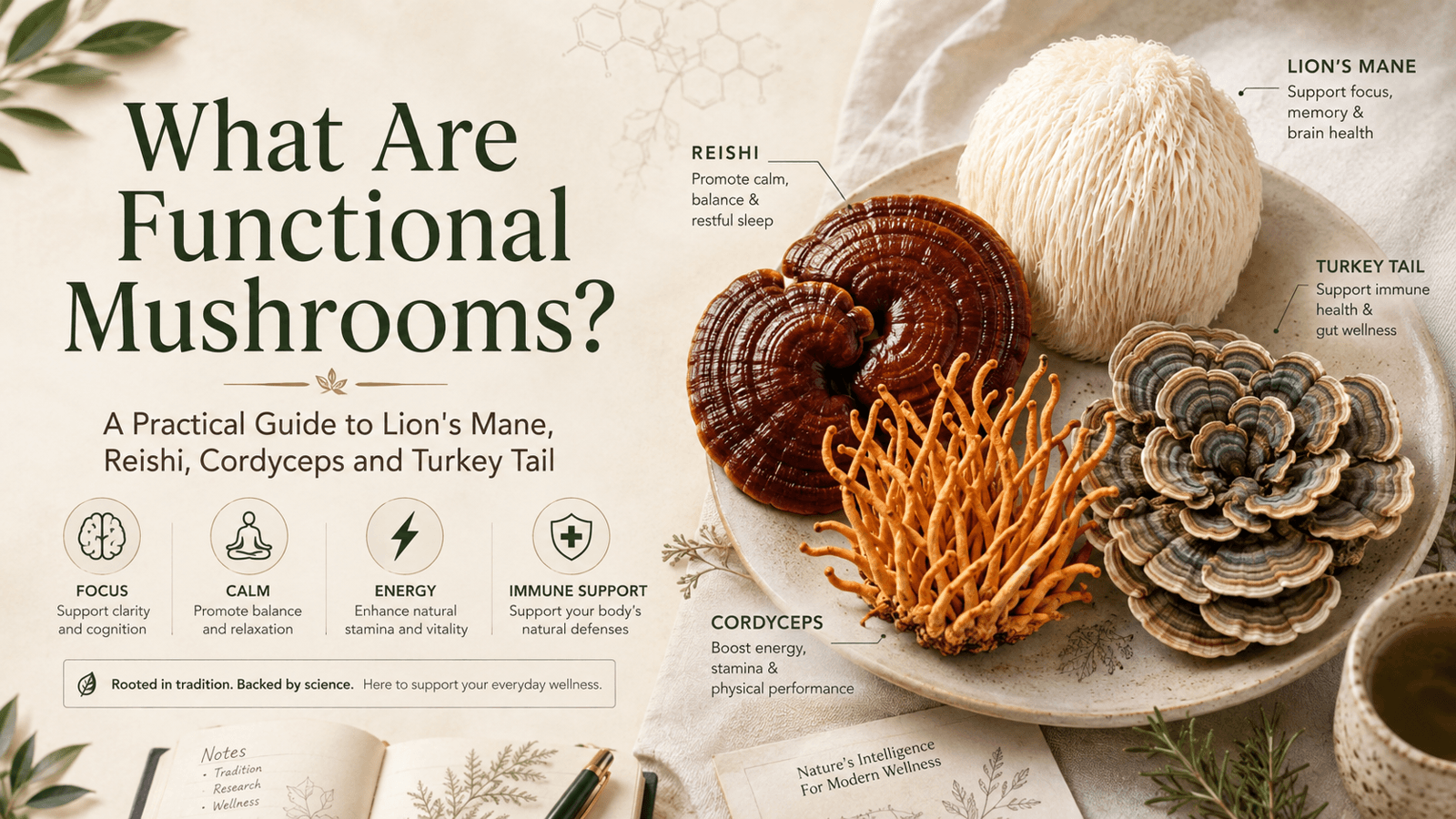
What Are Functional Mushrooms? A Practical Guide to Lion's Mane, Reishi, Cordyceps and Turkey Tail

SwedeVital Authority Engine™
SwedeVital
In short
Functional mushrooms are edible fungi chosen for their bioactive compounds—like beta‑glucans and triterpenes—rather than taste. The most popular species are Lion's Mane, Reishi, Cordyceps, and Turkey Tail, each offering distinct health benefits such as cognitive support, immune modulation, energy, and gut health.
- Functional mushrooms are medicinal fungi rich in bioactive compounds, with Lion's Mane, Reishi, Cordyceps, and Turkey Tail being the most common for cognitive, immune, energy, and gut health benefits.
In short: Functional mushrooms are edible fungi — such as Lion's Mane, Reishi, Cordyceps and Turkey Tail — valued for the naturally occurring compounds they contain rather than for use as a culinary ingredient. They have a long history of traditional use, are the subject of ongoing scientific study, and today reach consumers as capsules, dual-extract sprays and gummies.
Functional mushrooms have moved from specialist health stores to mainstream retail shelves in a remarkably short time. For buyers, that growth brings an obvious question: what sits behind the label, and how do you tell a considered product from a marketing exercise? This guide is a practical, evidence-led primer — for the buyers building a wellness range and for the shoppers they serve. It explains what the term means, how these fungi differ from the mushrooms on your dinner plate, what each of the four best-known species has traditionally been used for, and — crucially — what separates a quality extract from a filler-heavy powder.
What are functional mushrooms?
The phrase functional mushrooms describes a group of edible or medicinal fungi consumed primarily for their potential contribution to wellbeing rather than for flavour or texture. They are sometimes called "adaptogenic" or "tonic" mushrooms, borrowing language from traditional herbalism. What unites them is a set of naturally occurring compounds — most notably beta-glucans (a type of polysaccharide) alongside triterpenes and other constituents — that researchers continue to study for their biological activity.
It is worth being precise about language here. "Functional" is a market category, not a regulatory or medical one. In an EU context these products are sold as food supplements or foods, not as medicines. That distinction matters throughout this article: traditional use and early research are genuinely interesting, but they are not the same as an authorised health claim or a guaranteed outcome.
How functional mushrooms differ from culinary mushrooms
Every mushroom contains nutrients — button, chestnut and oyster mushrooms are perfectly nutritious foods. The distinction is one of purpose and preparation:
- Purpose. Culinary mushrooms are chosen for taste, texture and cooking. Functional mushrooms are chosen for their concentration of specific bioactive compounds.
- Species. The functional category centres on a handful of species — Lion's Mane, Reishi, Cordyceps, Turkey Tail, Chaga and Maitake among them — several of which are too woody, bitter or fibrous to eat as food.
- Preparation. Many of the compounds of interest are locked inside tough cell walls made of chitin, which is why functional mushrooms are typically extracted and concentrated rather than simply dried and eaten.
That last point is the key to understanding everything that follows about quality. The value of a functional mushroom product depends heavily on how it is grown, which part is used, and how it is processed.
A closer look at the four best-known functional mushrooms
Four species do most of the work in today's wellness ranges. Below is a fair summary of each: its traditional context and what it is commonly studied for. Note the careful language throughout — these are areas of research interest and traditional use, not promises.
Lion's Mane (Hericium erinaceus)
With its distinctive cascade of white spines, Lion's Mane is unusual among this group in that it is also a genuinely pleasant culinary mushroom. It has been traditionally used in parts of East Asia as a tonic, and it is the functional mushroom most often associated with cognitive and nervous-system themes. Contemporary research has studied its compounds (including hericenones and erinacines) in the context of focus, memory and nerve health, though the evidence base is still developing and much of it is early-stage. It is popular with consumers looking for a daily "clarity" or study-and-work supplement.
Reishi (Ganoderma lucidum)
Known in traditional Chinese medicine as lingzhi, the "mushroom of immortality," Reishi has one of the longest documented histories of any tonic fungus. It is woody and intensely bitter — firmly a supplement rather than a food. Reishi is rich in triterpenes and beta-glucans and is traditionally used as a calming, restorative tonic; it is commonly studied for immune modulation, stress resilience and sleep quality. Because of its calming associations, it is often positioned as an evening or wind-down product.
Cordyceps (Cordyceps militaris / Ophiocordyceps sinensis)
Cordyceps has a striking natural history and an equally strong reputation as an energy and stamina tonic. Traditionally prized by communities in the Himalayan region and later by athletes, it is traditionally used to support vitality and endurance, and research suggests interest in its role around oxygen utilisation, exercise performance and fatigue. Most commercial Cordyceps today is the cultivated C. militaris species rather than the rare, wild-harvested sinensis — a fact quality-minded buyers should know when comparing suppliers.
Turkey Tail (Trametes versicolor)
Named for its banded, fan-shaped fruiting bodies, Turkey Tail is one of the most-researched functional mushrooms in the scientific literature. It is a notably rich source of beta-glucans and is most commonly studied for immune support and gut health, with a long record of traditional use across several cultures. As a food-supplement ingredient it is usually taken as an extract or powder rather than eaten, given its tough, leathery texture.
Formats: capsules, dual-extract sprays and gummies
The same mushroom can reach a consumer in very different formats, and the right choice depends on the shopper as much as the ingredient. SwedeVital produces its range across three of the most practical formats, each with a clear use case:
- Capsules. The workhorse format. Capsules deliver a consistent, measured amount of extract with no taste, travel well and suit shoppers who want a simple daily routine. They are the natural home for higher-concentration extracts.
- Dual-extract sprays. A liquid extract delivered as a convenient spray. Sprays appeal to consumers who dislike swallowing capsules and who value fast, flexible, on-the-go use. The dual-extract element (explained below) is central to their value.
- Gummies. The most approachable, lowest-barrier format — useful for first-time buyers and for driving trial. Gummies trade some potency headroom for palatability, so they work best where taste and ease matter more than maximum concentration.
For a retailer, stocking more than one format is often smart merchandising: capsules for the committed daily user, sprays for convenience seekers, and gummies as an entry point that converts curious shoppers into the category.
What quality actually looks like
This is where informed buyers separate serious products from weak ones. A few concepts do most of the explaining, and understanding them lets you ask a supplier the right questions.
Dual extraction
Different beneficial compounds dissolve in different solvents. Beta-glucans are typically drawn out with hot water, while triterpenes and other constituents need alcohol. Dual extraction uses both processes so the finished product captures a fuller spectrum of the mushroom's compounds — which is why the method is so often highlighted on quality extracts, including well-made sprays. A single hot-water extract is not "bad," but for triterpene-rich species such as Reishi it may leave value behind.
Fruiting body vs mycelium
A mushroom has two main parts a producer can use: the fruiting body (the visible mushroom itself) and the mycelium (the root-like network it grows from, often cultivated on grain). Both can contain valuable compounds, and both appear in reputable products. The important issues are transparency and what actually ends up in the jar: mycelium grown on grain can carry residual starch that dilutes the active fraction unless it is properly separated, so shoppers and buyers are right to ask what the product is made from and how it is measured. There is no single "correct" answer here — only honest labelling.
Beta-glucan content and testing
Because beta-glucans are a headline class of active compound, a genuine quality signal is whether a producer measures and states beta-glucan content — ideally verified by independent laboratory testing — rather than relying on a vague "polysaccharide" percentage, which can be inflated by starch. Batch testing for contaminants and heavy metals is a further mark of a supplier that takes the category seriously.
Buyer's shortcut: named species (with Latin name), stated part used, extraction method, a real beta-glucan figure, and third-party testing. A product that is transparent on those five points is usually a considered one.
How to choose functional mushrooms for a range
If you are building or refreshing a wellness range, a simple way to structure it is by the consumer benefit shoppers already search for, matched to the mushroom traditionally associated with it:
- Focus and clarity — Lion's Mane, the everyday cognitive pick.
- Calm and sleep — Reishi, positioned as an evening ritual; it pairs naturally with a magnesium sleep product.
- Energy and performance — Cordyceps, aimed at active and athletic shoppers; a logical neighbour to creatine.
- Everyday defence and gut — Turkey Tail, the immune-and-microbiome staple.
Offer each across the format that fits the shopper — capsules, spray or gummy — and you cover the main entry points into the category without over-complicating the shelf. Keep the language evidence-led and compliant, and let transparency do the selling.
Frequently asked questions
Are functional mushrooms the same as psychedelic mushrooms?
No. Functional mushrooms such as Lion's Mane, Reishi, Cordyceps and Turkey Tail are non-psychoactive edible or medicinal fungi. They contain none of the psychedelic compounds found in "magic" mushrooms and are sold as ordinary food supplements.
Do functional mushrooms have proven health benefits?
They have a long history of traditional use and are an active area of scientific study, but this is a food-supplement category, not a medicine. It is accurate to say a mushroom is traditionally used for or has been studied for a purpose; it is not accurate to claim guaranteed medical outcomes. Anyone with a health condition or taking medication should speak to a healthcare professional.
What does "dual extract" mean, and does it matter?
Dual extraction combines a hot-water extract (which captures beta-glucans) with an alcohol extract (which captures triterpenes and other compounds), so the finished product reflects a fuller spectrum of the mushroom. It is particularly relevant for triterpene-rich species like Reishi and is a common feature of well-made extracts and sprays.
Capsules, sprays or gummies — which format is best?
There is no single best format; it depends on the user. Capsules suit consistent daily routines and higher concentrations, sprays suit convenience and people who dislike swallowing capsules, and gummies are the most approachable option for newcomers. Many ranges stock all three to serve different shoppers.
What should a buyer look for in a quality product?
Five signals: the named species with its Latin name, a clearly stated part used (fruiting body and/or mycelium), the extraction method, a real measured beta-glucan figure rather than a vague polysaccharide percentage, and independent third-party testing for potency and contaminants.
Can you take more than one functional mushroom at a time?
Many people use combinations — for example a focus mushroom by day and a calming one in the evening — and blends are widely available. As with any supplement, sensible use and, where relevant, professional advice are the right starting points, especially alongside existing medication.
Related reading
Frequently asked questions
What makes a mushroom 'functional' rather than just edible?+
Functional mushrooms are selected for their concentrated bioactive compounds—mainly beta‑glucans, triterpenes, and other phytochemicals—rather than for flavor or texture. They are typically extracted and concentrated to deliver these benefits.
Which format is best for daily use?+
Capsules are the most common and convenient format for daily use, offering a consistent dose, no taste, and easy travel. Sprays and gummies are good alternatives for those who prefer a quick, flavored option.
How can I tell a quality extract from a filler-heavy powder?+
Look for products that specify the mushroom species, the part used (e.g., fruiting body), the extraction method (water or dual‑extract), and provide third‑party lab testing. Avoid vague claims and check for standardized beta‑glucan content.
Is Cordyceps sinensis the same as Cordyceps militaris?+
No. Cordyceps sinensis is a rare, wild‑harvested species, while most commercial Cordyceps are cultivated C. militaris. The latter is more affordable and widely available, but may differ in potency and composition.
Can I eat Turkey Tail like a regular mushroom?+
Turkey Tail has a tough, leathery texture and is usually consumed as an extract or powder rather than cooked. Its primary use is as a supplement for immune and gut health.
See the full SwedeVital range
Every line, every format, and what it takes to stock them — sent to you now, before we open for orders on 1 January 2027.
Written by
SwedeVital Authority Engine™
Last updated
30 August 2026