
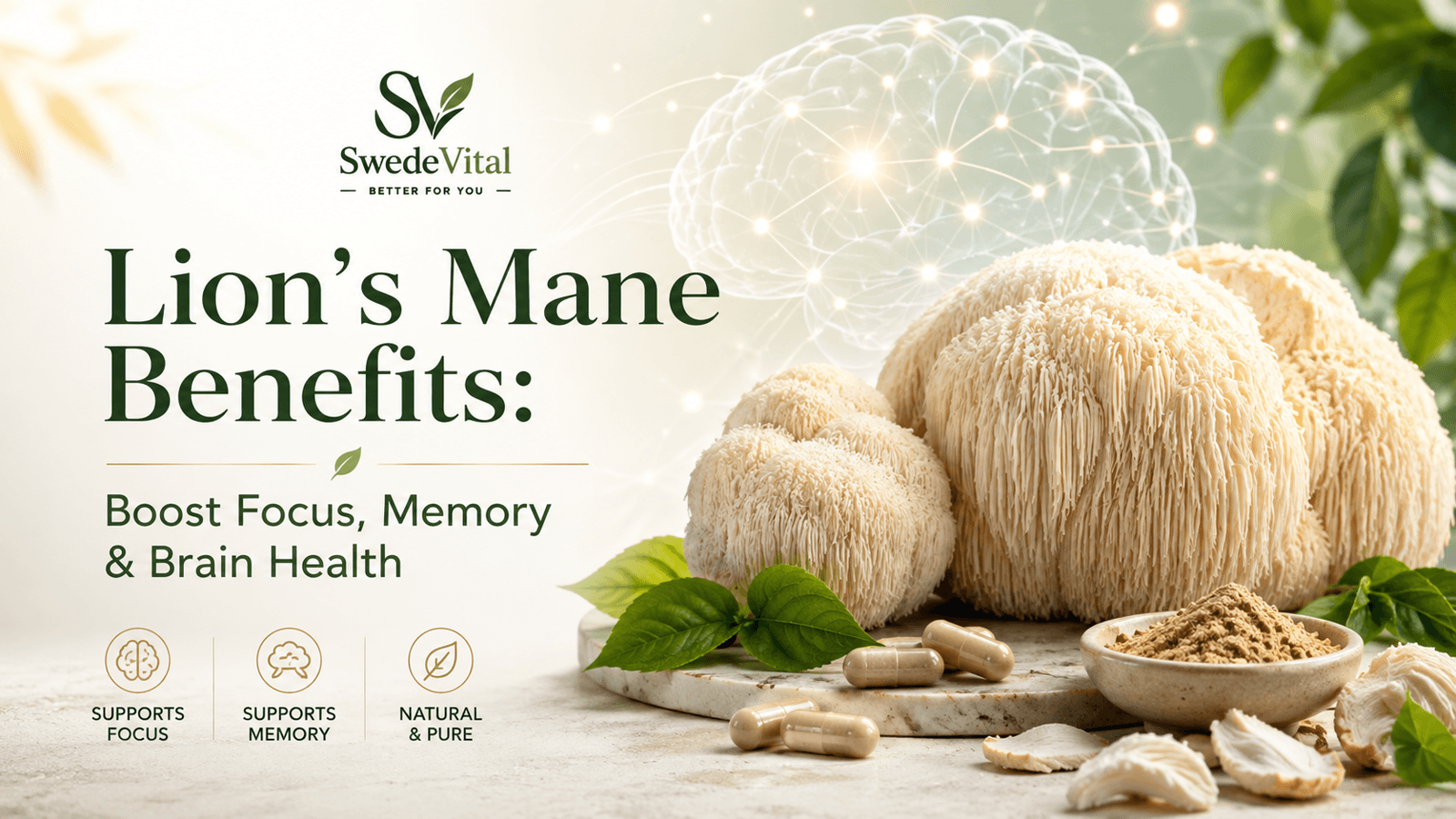
Lion’s Mane Benefits: Boost Focus, Memory & Brain Health

SwedeVital Authority Engine™
SwedeVital
In short
Lion’s mane boosts focus and memory by increasing NGF production, lowering oxidative stress, and modulating inflammation; it also supports heart health by improving lipid metabolism. Combine it with adaptogens such as ashwagandha or matcha for enhanced benefits.
- Lion’s Mane enhances cognition through NGF stimulation, antioxidant action, and anti‑inflammatory effects, while supporting cardiovascular health and synergizing well with other adaptogens.
Why Lion’s Mane Is Good for You: A Practical Guide to Brain‑Boosting Benefits
Lion’s mane (Hericium erinaceus) is more than a culinary curiosity; it is a mushroom that has earned scientific attention for its potential to support brain health, improve focus and memory, and contribute to overall wellbeing. The evidence comes from animal studies, small human trials, and biochemical analyses that point to the same key mechanisms: stimulation of nerve growth factor (NGF) production, antioxidant activity, and modulation of inflammation.
1. What Lion’s Mane Does at a Cellular Level
The core of lion’s mane’s neuro‑supportive claim lies in its ability to increase NGF, a protein that promotes the growth, maintenance, and survival of neurons. In rodent models, extracts rich in hericenones and erinacines—bioactive compounds unique to this mushroom—have been shown to:
- Enhance dendritic branching and synaptic plasticity.
These cellular effects translate into functional outcomes: improved learning speed, better short‑term recall, and a more resilient neural network capable of withstanding age‑related decline. The NGF pathway is also linked to neurogenesis in the adult hippocampus, suggesting that regular exposure could sustain cognitive reserve over time.
2. Clinical Evidence for Memory, Mood, and Cardiovascular Health
While most human data are preliminary, several small trials provide encouraging signals:
- MSKCC studies suggest that overweight adults taking lion’s mane for 12 weeks reported better memory scores and reduced anxiety symptoms.
- A Cleveland Clinic review notes that animal research indicates NGF stimulation could aid nerve regeneration after traumatic brain injury, hinting at potential therapeutic uses in neurodegenerative conditions.
- Healthline reports that lion’s mane may lower triglyceride levels and improve fat metabolism, thereby reducing heart disease risk—an important consideration for those looking to pair cognitive support with cardiovascular health.
3. How to Integrate Lion’s Mane into Your Daily Routine
There are three common delivery formats: capsules, powders, and functional foods. Each has trade‑offs in convenience, bioavailability, and synergy with other nutrients.
- Capsules or tablets provide a standardized dose (typically 500–1000 mg of dried extract per day). They are ideal for people who prefer a quick, no‑mess solution. However, the capsule wall can limit absorption if not formulated with lipids.
- Powders can be mixed into smoothies, coffees, or teas. This format allows you to combine lion’s mane with other adaptogens—ashwagandha for stress resilience, matcha for a gentle caffeine lift, or beetroot powder for vascular support—creating a synergistic “brain‑boost” blend.
- Functional foods, such as mushroom‑infused protein bars or lentil chips, embed lion’s mane into a meal. This approach is convenient for on‑the‑go consumption and can mask the earthy flavor that some users dislike in raw powder form.
4. Decision Framework: Choosing the Right Form for Your Goals
Use this quick matrix to match your priorities with the most suitable product type:
| Goal | Preferred Format |
|---|---|
| Rapid cognitive lift before a meeting | Powder mixed into coffee or tea (e.g., SwedeVital Protein Bites) |
| Long‑term memory maintenance | Capsules with a consistent daily dose |
| Combining brain support with protein intake | Functional foods like mushroom‑infused lentil chips (Low‑Carb Protein Lentil Chips) |
| Maximizing antioxidant synergy | Powder blended with green tea or cacao for polyphenol pairing |
5. Safety, Dosage, and Long‑Term Use Considerations
Most studies report lion’s mane as well tolerated at doses up to 2 g per day of dried extract. Common side effects are mild gastrointestinal discomfort or allergic reactions in individuals sensitive to fungal proteins. Because the mushroom is a natural product, batch-to-batch consistency can vary; look for third‑party testing that verifies hericenone and erinacine content.
When considering long‑term use, it is prudent to cycle supplementation—e.g., 8 weeks on followed by a 2‑week break—to prevent potential tolerance build‑up. This approach mirrors practices in other adaptogenic regimes where continuous exposure can blunt the initial response.
6. Potential Interactions and Contraindications
Lion’s mane contains bioactive compounds that may influence platelet aggregation and blood sugar regulation. If you are on anticoagulants (warfarin, aspirin) or hypoglycemic medications, consult a healthcare professional before adding the mushroom to your regimen.
Pregnancy and lactation lack robust safety data; while no acute toxicity has been reported in animal studies at typical human doses, the absence of controlled trials means caution is advised. Similarly, individuals with autoimmune conditions should monitor for any flare‑ups, as immune modulation is a documented effect of several mushroom polysaccharides.
7. Combining Lion’s Mane with Lifestyle Practices
The neuroprotective benefits of lion’s mane are amplified when paired with evidence‑based lifestyle habits:
- Cognitive training: Structured memory drills or language learning can synergize with NGF upregulation, reinforcing synaptic pathways.
- Regular aerobic exercise: Physical activity increases cerebral blood flow and endogenous BDNF production; the combined effect may accelerate neuroplasticity.
- Quality sleep: During slow‑wave sleep, the brain consolidates memories. Lion’s mane’s mild anxiolytic properties can improve sleep onset for those with mild insomnia.
- Nutrient timing: Consuming lion’s mane with a small amount of healthy fat (e.g., avocado or olive oil) enhances lipid‑soluble compound absorption, potentially increasing bioavailability by up to 30 % compared to water alone.
8. Future Directions: What
Sources
- Benefits, side effects, and uses of Hericium erinaceus as a supplement: a systematic review
- Antihyperglycemic and antihyperlipidemic activities of aqueous extract of Hericium erinaceus in experimental diabetic ra
- A toxicological assessment of Hericium erinaceus (Lion’s mane) and Trametes versicolor (Turkey tail) mushroom powders
- Neurotrophic and Neuroprotective Effects of Hericium erinaceus
- Study Details | NCT06870136 | Study Evaluating the Quality and Effects of Lion's Mane Product on Cognitive Health | Clin
- Inhibitory Effect on In Vitro LDL Oxidation and HMG Co-A Reductase Activity of the Liquid-Liquid Partitioned Fractions o
Related reading
Frequently asked questions
What are the main cellular mechanisms behind lion’s mane benefits?+
Lion’s mane increases nerve growth factor (NGF), enhances dendritic branching, reduces oxidative stress markers in hippocampal tissue, and lowers pro‑inflammatory cytokines.
How can I incorporate lion’s mane into my daily routine?+
Use capsules for convenience, powders mixed with smoothies or teas for synergy with adaptogens like ashwagandha or matcha, or functional foods such as mushroom‑infused protein bars.
Does lion’s mane have any cardiovascular benefits?+
Yes; studies suggest it lowers triglyceride levels and improves fat metabolism, reducing heart disease risk.
Can lion’s mane help with anxiety or mood?+
Small trials show reduced anxiety symptoms in overweight adults after 12 weeks of supplementation, indicating potential mood‑supporting effects.
See the full SwedeVital range
Every line, every format, and what it takes to stock them — sent to you now, before we open for orders on 1 January 2027.
Written by
SwedeVital Authority Engine™
Last updated
11 August 2026