
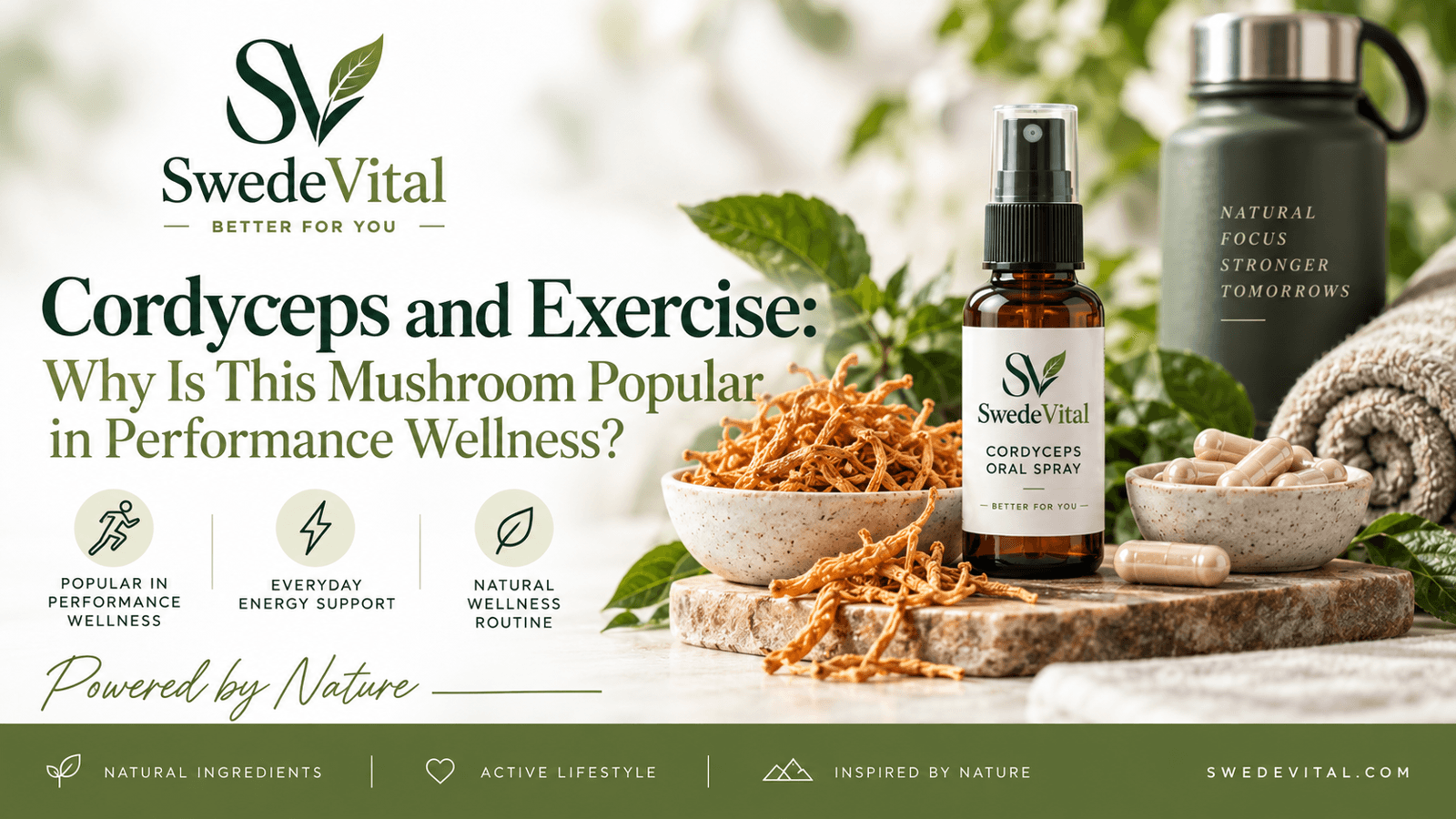
Cordyceps and Exercise: Why Is This Mushroom Popular in Performance Wellness?

SwedeVital Authority Engine™
SwedeVital
In short
Cordyceps is a medicinal mushroom traditionally used to support energy and endurance. Research suggests it may improve aerobic performance and recovery in some people, especially with consistent use over weeks, but results are mixed and it is not a stimulant or instant pre‑workout boost.
- Cordyceps may enhance aerobic performance and recovery with regular use, but evidence is mixed and it’s not an instant pre‑workout stimulant.
Cordyceps for exercise is popular in performance wellness because this fungus has a long history of traditional use for stamina and vitality, and modern researchers have studied it for its possible role in oxygen use, aerobic capacity and recovery. It is best understood as a supportive, well-tolerated addition to a training routine rather than a shortcut. Below is a buyer-and-consumer primer on what Cordyceps is, what the evidence actually shows, and how to judge quality on the shelf.
Quick answer: Cordyceps is a medicinal mushroom traditionally used to support energy and endurance. Research suggests it may support aspects of aerobic performance and recovery in some people, but results are mixed and it is not a stimulant, a pre-workout “boost” you feel instantly, or a substitute for training, sleep and nutrition.
What is Cordyceps, and why does it matter for exercise?
Cordyceps is a genus of fungi that has been used for centuries in Traditional Chinese Medicine, where it was valued for supporting vitality, stamina and the lungs. Two names dominate the modern market, and the distinction matters when you evaluate Cordyceps for exercise:
- Ophiocordyceps sinensis (historically Cordyceps sinensis) — the rare, wild high-altitude species from the Tibetan plateau. True wild material is scarce and expensive, so most reputable products use a cultivated, fermented mycelial strain derived from it, commonly labelled CS-4.
- Cordyceps militaris — a species that can be cultivated at scale and is often chosen because it can be grown as a fruiting body and tends to be studied for its content of cordycepin, a compound of research interest.
Both are genuine Cordyceps, but they are not interchangeable, and neither is a wild-harvested caterpillar fungus despite the marketing folklore. For a retail range, knowing which species and which part of the fungus you are selling is the foundation of an honest label.
Why is Cordyceps popular in performance wellness?
The appeal rests on three overlapping ideas. First, tradition: Cordyceps has been used for generations as a tonic for endurance and recovery, which gives it a credible heritage story that resonates with consumers who prefer time-tested botanicals over synthetic actives. Second, an energy narrative that is not caffeine: shoppers increasingly want to support stamina without the jitter, crash or sleep disruption of stimulants, and Cordyceps fits that “calm energy” positioning. Third, a plausible mechanism: because the mushroom has been studied in the context of oxygen utilisation and cellular energy, it slots naturally into an endurance and recovery story.
For a category manager, that combination is commercially useful: Cordyceps bridges the sports-nutrition aisle and the functional-mushroom trend, appealing to runners, cyclists, gym-goers and the broader wellness shopper at once.
What does the research actually suggest?
Here is the honest picture. Cordyceps has been studied for endurance, oxygen uptake (VO₂), aerobic capacity and fatigue, and some small trials point to possible benefits — particularly in older or less-trained individuals and with consistent use over several weeks. Other studies, especially in already well-trained athletes, have found little or no measurable effect. In other words, research suggests Cordyceps may support aspects of aerobic performance for some people, but the evidence is mixed and far from a guarantee.
Compounds often cited in this research include cordycepin and adenosine (studied in relation to cellular energy) and beta-glucans (associated with the mushroom’s traditional tonic reputation). It is important to be precise: these are areas of investigation, not settled proof, and Cordyceps is a food supplement, not a medicine. It should never be presented as treating, curing or preventing any condition.
Editorial guardrail: Under EU food-supplement rules, wellness products must not carry unauthorised health claims. Responsible language stays with “traditionally used for”, “has been studied for” and “may support” — never “boosts performance” or “increases VO₂ max” as a promise.
Cordyceps is not a pre-workout: how it actually fits a routine
One of the most common misunderstandings is treating Cordyceps like a caffeine-based pre-workout. It does not work that way. Cordyceps is best thought of as a daily, cumulative supplement: any potential benefits are associated with consistent use over weeks, not a single dose 30 minutes before a session. That distinction changes how you market it. Positioning it as an “instant energy” hit sets up disappointment; positioning it as a “foundation for stamina and recovery, taken daily” is both more honest and more likely to earn repeat purchases.
It also pairs logically with the rest of a performance stack. Many endurance-minded shoppers combine it with creatine for strength and power output and magnesium for muscle function and sleep quality — the two areas Cordyceps does not directly address. A range that carries Cordyceps alongside creatine and magnesium tells a complete, credible performance-and-recovery story without over-promising on any single item.
CS-4 versus Cordyceps militaris: which should a buyer stock?
There is no single “best” Cordyceps — there is the right fit for your shelf and your customer. Use these trade-offs:
Fermented CS-4 mycelium (from O. sinensis)
Consistent, scalable and backed by much of the classic endurance research, which was often conducted on CS-4-type material. It is a safe, well-understood choice for a mainstream endurance positioning. The caveat: it is mycelium, so the label should say so rather than implying wild caterpillar fungus.
Cordyceps militaris fruiting body
Often favoured by the “whole fruiting body” purist segment and by shoppers who look specifically for cordycepin content. It suits a premium, transparency-led positioning. The caveat: quality varies widely, so third-party testing matters even more.
For most retailers, the decision is really about your audience: a broad wellness customer is well served by clearly labelled CS-4; a discerning, ingredient-literate customer may prefer fruiting-body militaris with test data to match.
Formats: capsules, dual-extract sprays, gummies and powders
The same mushroom performs very differently as a product depending on format, and each has a clear job:
- Capsules — the workhorse for a daily regimen. Precise, portable, no taste, easy to communicate dosage. Best for committed users building a routine.
- Dual-extract sprays / tinctures — fast, flexible and appealing to the ritual-driven shopper; convenient for those who dislike swallowing capsules. Extraction method is the story here, so it must be genuine.
- Gummies — the accessibility and habit-formation play. They lower the barrier for newcomers and travel well as an impulse or trial purchase, though they carry less active per serving and add sugars, which the label should be honest about.
- Powders — for the mix-it-yourself crowd who add Cordyceps to coffee, smoothies or a training shake, and who want to control the dose.
A crucial point for functional mushrooms generally: extraction matters. Beta-glucans in mushrooms are locked inside tough, chitin-rich cell walls, so hot-water extraction is typically used to make them more available. A product that is merely ground raw mushroom or unspecified “mycelium on grain” is not the same as a properly extracted one. When a format is described as “dual-extract”, that should mean a real, disclosed process — not a marketing word.
A buyer’s quality checklist for Cordyceps
Whether you are sourcing for private label or curating brands to stock, run every Cordyceps product through this checklist before it earns a place on the shelf:
- Species clarity. Does the label state the exact species (O. sinensis / CS-4 or C. militaris) and the part used (mycelium or fruiting body)? Vague “Cordyceps” with no detail is a red flag.
- Extraction disclosed. Is the extraction method stated (e.g. hot-water), and is there an extract ratio or standardisation, such as a beta-glucan figure — not just “polysaccharides”, which can include grain starch?
- Third-party testing. Is there independent lab testing for heavy metals, contaminants and actual active content? Mushrooms concentrate what they grow in, so this is non-negotiable.
- Honest dosage. Is the serving size realistic and consistent with how the material was studied, rather than a token “fairy dust” amount?
- Compliant claims. Does the marketing stay within “traditionally used / may support” language and avoid promising medical outcomes?
- Traceability. Is the origin and manufacturing standard clear? For an EU range, documented sourcing and GMP-grade manufacturing protect both you and your customer.
If a supplier cannot answer these questions with documentation, that in itself is the answer.
Who is Cordyceps for — and who should be cautious?
Cordyceps for exercise suits endurance-oriented adults — runners, cyclists, hikers, gym regulars — and the broad wellness shopper who wants sustained energy without stimulants. It is generally well tolerated. That said, responsible retail means clear guidance: Cordyceps is a food supplement, not a replacement for a varied diet, and it is not intended to diagnose, treat or cure anything.
Certain shoppers should speak to a healthcare professional first — anyone who is pregnant or breastfeeding, people on blood-thinning or immune-modulating medication, those with an autoimmune condition, and anyone preparing for surgery. Signposting this openly is not a weakness in your copy; it is exactly the kind of trustworthy detail that buyers and end-consumers reward with loyalty.
The bottom line for buyers and consumers
Cordyceps has earned its place in performance wellness through a genuine heritage, a stimulant-free energy story and real scientific curiosity about its role in endurance and recovery. The evidence is promising but mixed, so the winning approach — commercially and ethically — is to sell it accurately: a daily, cumulative botanical that may support stamina and recovery, backed by species clarity, disclosed extraction and third-party testing. Sold that way, Cordyceps is not hype; it is a durable, trust-building anchor for a modern functional range.
Related reading
Sources
- Cordyceps and Exercise: 5 Ways It May Support Athletic Performance | Mycobio
- Frontiers | Effects of fungal supplementation on endurance, immune function, and hematological profiles in adult athlete
- Cordyceps – A traditional Chinese medicine and another fungal therapeutic biofactory?
- Genetic diversity of Ophiocordyceps sinensis, a medicinal ...
- The Conservation Crisis of Ophiocordyceps sinensis: Strategies, Challenges, and Sustainable Future of Artificial Cultiva
- Enhanced production of cordycepin under solid-state fermentation of Cordyceps militaris by using combinations of grains/
Frequently asked questions
What is Cordyceps and why is it used for exercise?+
Cordyceps is a genus of fungi used in Traditional Chinese Medicine for stamina and vitality. Modern studies focus on its potential to improve oxygen utilization, aerobic capacity, and recovery, making it popular in performance wellness.
Which Cordyceps species should I choose for training?+
Ophiocordyceps sinensis (CS‑4 mycelium) is widely studied for endurance, while Cordyceps militaris fruiting bodies are favored by purists. Choose based on your target audience and labeling clarity.
Does Cordyceps give an instant energy boost before workouts?+
No. Cordyceps works as a daily, cumulative supplement; benefits appear after consistent use over weeks, not from a single pre‑workout dose.
Can Cordyceps replace training, sleep, or nutrition?+
No. It is a supportive supplement that should complement proper training, adequate sleep, and balanced nutrition, not replace them.
What are the key compounds in Cordyceps that may affect performance?+
Cordycepin, adenosine, and beta‑glucans are studied for their roles in cellular energy and immune support, but evidence remains mixed and not conclusive.
See the full SwedeVital range
Every line, every format, and what it takes to stock them — sent to you now, before we open for orders on 1 January 2027.
Written by
SwedeVital Authority Engine™
Last updated
19 September 2026