
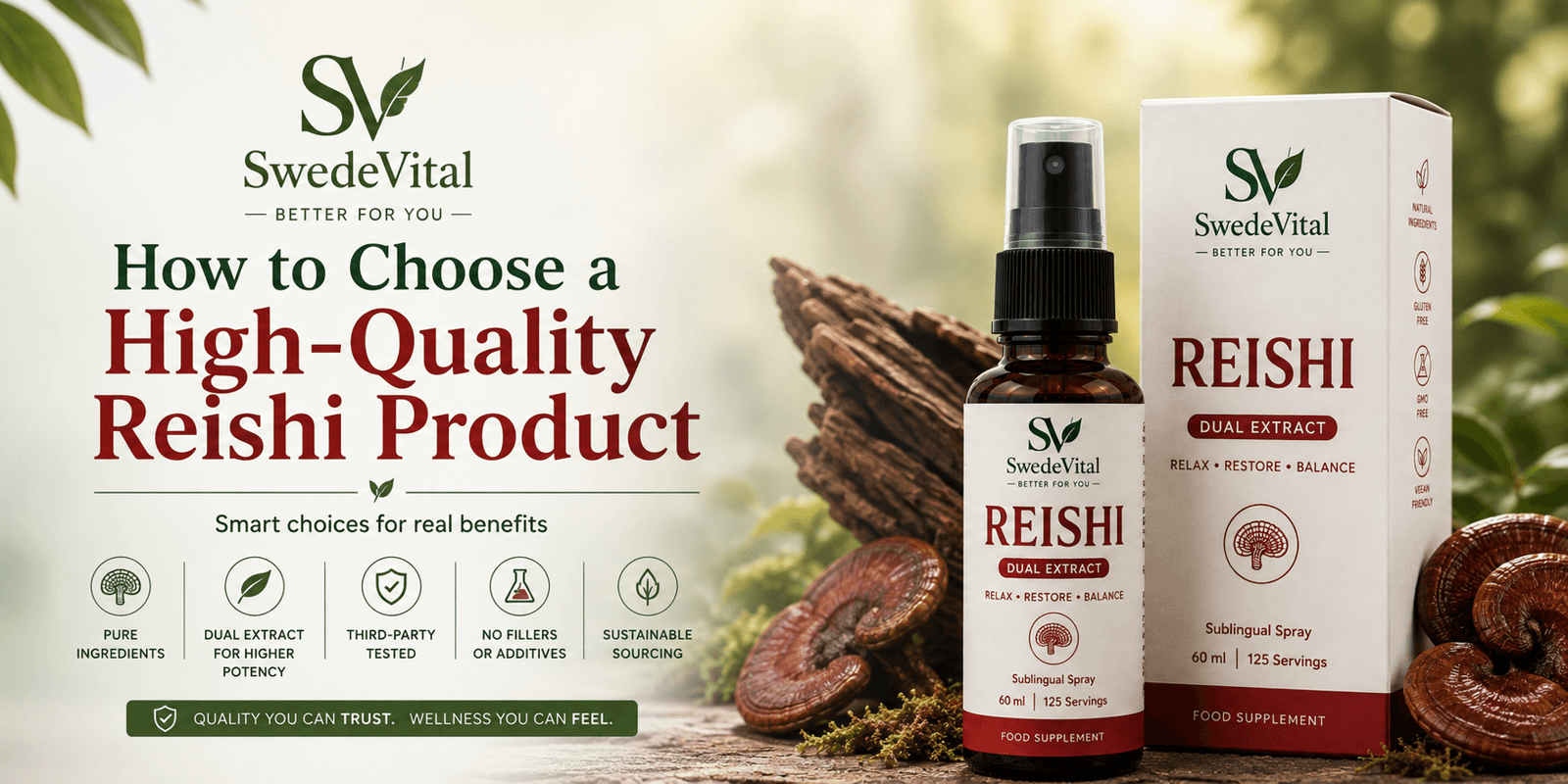
How to Choose a High-Quality Reishi Product

SwedeVital Authority Engine™
SwedeVital
In short
A high‑quality Reishi product is made from verified Ganoderma lucidum fruiting body, dual‑extracted with hot water and alcohol, standardized to beta‑glucan content, and backed by independent third‑party lab testing for identity, heavy metals, and contaminants.
- High‑quality Reishi is verified fruiting body, dual‑extracted, beta‑glucan‑standardized, and third‑party tested for purity.
A high quality Reishi product is one made from verified Ganoderma lucidum fruiting body, dual-extracted with both hot water and alcohol, standardised to a stated beta-glucan content rather than a vague "polysaccharide" number, and backed by independent third-party lab testing for identity, heavy metals and contaminants. Everything else — extract ratios, format, branding, packaging — is secondary to those four fundamentals. This primer walks retail buyers, distributors and the shoppers they serve through exactly what separates a serious Reishi from a filler-heavy one, so you can specify, source or shelve with confidence.
What "high quality Reishi" actually means
Reishi (Ganoderma lucidum, also called lingzhi in China and reishi in Japan) has been used in East Asian herbal traditions for centuries. It is one of the most recognised functional mushrooms on the market, which unfortunately means it is also one of the most inconsistently made. Two products on the same shelf, at similar prices, can differ enormously in what they actually contain.
Quality is defined by what is inside the capsule, gummy or bottle — not by the artwork on the label. When you strip away marketing language, a genuinely high quality Reishi rests on four pillars:
- Authenticity — the correct species and the correct part of the mushroom.
- Extraction — a method that makes the active compounds available to the body.
- Transparency — a label that quantifies the compounds that matter.
- Purity — verified, contaminant-tested raw material.
For buyers and category managers, add a fifth: documentation. A supplier who cannot produce a batch certificate of analysis (COA) on request is asking you to take quality on trust, and trust is not a specification.
Fruiting body vs mycelium: the first thing to check
The single most common quality gap in the mushroom category is what part of the organism you are actually buying. The fruiting body is the mushroom you would recognise — the woody, fan-shaped cap that traditional use is built around. Mycelium is the fine, root-like network the fungus grows before it fruits.
Mycelium is not inherently worthless, but in supplements it is frequently grown on a grain substrate (rice or oats) and sold as "mycelium on grain" or under vaguer terms like "full spectrum". The finished powder then contains a large proportion of the leftover grain, which dilutes the active fungal compounds and inflates crude "polysaccharide" figures with grain starch. If a label does not clearly state fruiting body, assume you need to ask. A serious supplier will tell you the part used without hesitation, in writing.
Why dual extraction matters
Reishi's studied compounds fall into two broad, chemically different groups, and no single solvent captures both:
- Beta-glucans and other polysaccharides are water-soluble. They are drawn out with hot water.
- Triterpenes (the bitter ganoderic acids that give Reishi its characteristic taste) are largely alcohol-soluble. They are drawn out with an ethanol extraction.
A water-only extract misses much of the triterpene fraction; an alcohol-only extract misses much of the polysaccharide fraction. Dual extraction — hot water plus alcohol, then recombined — is the method that captures both, and it is a hallmark of a considered product. A useful sensory cue for consumers: real Reishi extract is noticeably bitter. If a "Reishi" tastes of nothing, ask what was actually extracted.
Raw, unextracted mushroom powder is a different thing again. Its active compounds sit behind tough, chitin-rich cell walls, so extraction (or at least careful processing) is what makes them more available. "Powder" on a label is not automatically a red flag, but it should prompt the question: extracted, or just milled?
Read the label like a scientist
Once species and part are settled, the label is where quality becomes measurable. Look for, in order of importance:
- Species, named in full (Ganoderma lucidum / lingzhi).
- Part used — fruiting body, mycelium, or spore.
- Extraction method — ideally dual (water and alcohol).
- Beta-glucan content, stated as a percentage — this is the marker that matters.
- Dose per serving in milligrams of extract.
The most important nuance here is beta-glucans versus "polysaccharides". Beta-glucans are the fungal compounds of interest. "Total polysaccharides", by contrast, can include alpha-glucans — and starch is an alpha-glucan. A product grown on grain can therefore advertise an impressive "polysaccharides ≥ 30%" while much of that number is simply leftover rice. A label that quantifies beta-glucans specifically is telling you something meaningful; one that only quotes total polysaccharides may be hiding filler behind a big-looking figure.
Treat extract ratios (like 10:1) as context, not proof. A ratio tells you how much raw material was notionally reduced, but it says nothing about the starting quality or the final beta-glucan content. A well-characterised extract with a stated beta-glucan percentage is more informative than an impressive-sounding ratio on its own.
Purity and third-party testing
Mushrooms are bioaccumulators: they efficiently draw up whatever is in their growing substrate and environment, including heavy metals such as lead, arsenic, cadmium and mercury. That biology is exactly why they can be valuable — and exactly why independent testing matters more for mushrooms than for many other ingredients. Quality here is not something you can see, taste or smell; it has to be verified in a laboratory.
A credible product should be able to show a batch-level certificate of analysis covering:
- Identity — confirmation the material is the stated species.
- Beta-glucan content — the actual measured active fraction.
- Heavy metals — within recognised safe limits.
- Microbiological safety — yeast, mould and bacterial counts.
- Pesticide residues, where relevant to the source.
For B2B and private-label buyers, go one step further: ask for testing by batch (not a single historical certificate), confirm manufacture under a recognised quality system such as GMP, and require traceability back to the country and method of cultivation. Reputable manufacturers, SwedeVital included, expect these questions and answer them with paperwork rather than reassurance.
Choosing a format: capsules, sprays and gummies
Format is a delivery decision, not a quality decision — a well-made extract can be excellent in any of them, and a poor one is poor in all of them. Match the format to the shopper, then hold every format to the same standards above.
Capsules
Precise, consistent dosing with no taste to manage — the natural fit for a daily routine and the easiest format on which to verify extract and beta-glucan content per serving.
Dual-extract sprays and tinctures
Fast and flexible, with dose you can adjust drop by drop or spray by spray. The trade-off is Reishi's genuine bitterness and an alcohol carrier that will not suit everyone.
Gummies
The most palatable and approachable option, and often the best way to convert reluctant or first-time users. The watch-outs are added sugar and, sometimes, a lower quantity of actual actives per serving — so a good Reishi gummy still states its extract and, ideally, its beta-glucan content rather than hiding behind flavour.
SwedeVital's functional-wellness line carries Reishi across capsules, dual-extract sprays and gummies precisely because different retail audiences reach for different formats — but the underlying extract specification is what a buyer should scrutinise first.
A buyer's checklist for high quality Reishi
Use this as a quick screen before you specify, list or restock a high quality Reishi line. If a product cannot answer most of these in writing, keep looking:
- Is the species named in full as Ganoderma lucidum?
- Does it clearly state fruiting body (not undisclosed mycelium-on-grain)?
- Is it dual-extracted (water and alcohol)?
- Is beta-glucan content quantified — not just "polysaccharides"?
- Is the dose per serving clearly stated in milligrams?
- Is a batch-level COA available, covering identity, heavy metals, microbials and pesticides?
- Is manufacture under a recognised quality system (e.g. GMP), with traceable origin?
- Is the health messaging honest and non-committal, without disease claims?
What the research says about reishi mushroom benefits
Because "reishi mushroom benefits" is one of the most searched questions in this category, it deserves a careful, honest answer. Reishi has been traditionally used in East Asian herbal systems as a tonic associated with vitality and calm. In modern science, it has been studied for areas including immune modulation, sleep and stress, and antioxidant activity. That research is still developing and much of it is preliminary, so the responsible framing is that Reishi may support general wellbeing as part of a balanced lifestyle — not that it treats, cures or prevents any condition.
This matters commercially as well as ethically. In the EU, there are no authorised health claims for Reishi, so any product or listing that promises specific medical outcomes is a compliance risk you do not want on your shelves or your site. Responsible messaging keeps every claim evidence-led and conditional. Reishi is a food supplement, not a medicine; it does not replace a varied diet or medical care. Anyone who is pregnant or breastfeeding, taking blood-thinning or immune-modulating medication, or managing a health condition should speak to a qualified healthcare professional before use.
Frequently asked questions
What are reishi mushroom benefits?
Reishi has been traditionally used in East Asian herbal traditions and has been studied for immune modulation, sleep, stress and antioxidant activity. Current evidence is still developing, so it is best described as something that may support general wellbeing rather than a treatment for any condition. It is a food supplement, not a medicine.
How can you tell if a Reishi supplement is high quality?
Check four things: it names Ganoderma lucidum fruiting body, it is dual-extracted (water and alcohol), it quantifies beta-glucans rather than only "polysaccharides", and it is backed by a batch certificate of analysis covering identity, heavy metals and contaminants. Those four fundamentals matter far more than extract ratios or branding.
What is the difference between fruiting body and mycelium Reishi?
The fruiting body is the recognisable mushroom that traditional use is based on. Mycelium is the root-like growth stage, and in supplements it is often grown on grain, which dilutes the active compounds and can inflate crude polysaccharide figures with starch. For most buyers, a clearly stated fruiting-body extract is the safer specification.
What does "dual extraction" mean and why does it matter?
Dual extraction uses both hot water and alcohol. Water pulls out the water-soluble beta-glucans; alcohol pulls out the alcohol-soluble triterpenes (the bitter ganoderic acids). Using both captures the full range of Reishi's studied compounds, which a single-solvent method would partly miss.
Why should Reishi be third-party tested?
Mushrooms are bioaccumulators and can take up heavy metals such as lead, arsenic and cadmium from their growing environment. Purity cannot be seen or tasted, so independent laboratory testing — ideally batch by batch — is the only reliable way to confirm both safety and the actual beta-glucan content.
Capsules, spray or gummies — which format is best?
None is inherently superior; format is about the end user. Capsules give precise, taste-free daily dosing; dual-extract sprays give flexible dosing but a bitter, alcohol-based taste; gummies are the most approachable but should still declare their actives and watch added sugar. Hold every format to the same species, extraction and testing standards.
Related reading
Frequently asked questions
What is the difference between fruiting body and mycelium Reishi?+
Fruiting body is the mushroom cap used in traditional medicine; mycelium is the root‑like network grown on grain, which dilutes active compounds and inflates polysaccharide figures.
Why is dual extraction important for Reishi supplements?+
Beta‑glucans are water‑soluble and triterpenes are alcohol‑soluble; dual extraction captures both, ensuring a full spectrum of active compounds.
How can I verify the beta‑glucan content on a Reishi label?+
Look for a stated percentage of beta‑glucan; avoid labels that only list total polysaccharides, which may include filler starch.
What should a third‑party lab test cover for Reishi products?+
Identity confirmation, beta‑glucan content, heavy metals, microbiological safety, and pesticide residues if applicable.
What is a certificate of analysis and why is it important?+
A batch‑level COA provides independent verification of species, beta‑glucan levels, and contaminant limits, giving buyers confidence in product purity.
See the full SwedeVital range
Every line, every format, and what it takes to stock them — sent to you now, before we open for orders on 1 January 2027.
Written by
SwedeVital Authority Engine™
Last updated
1 September 2026