
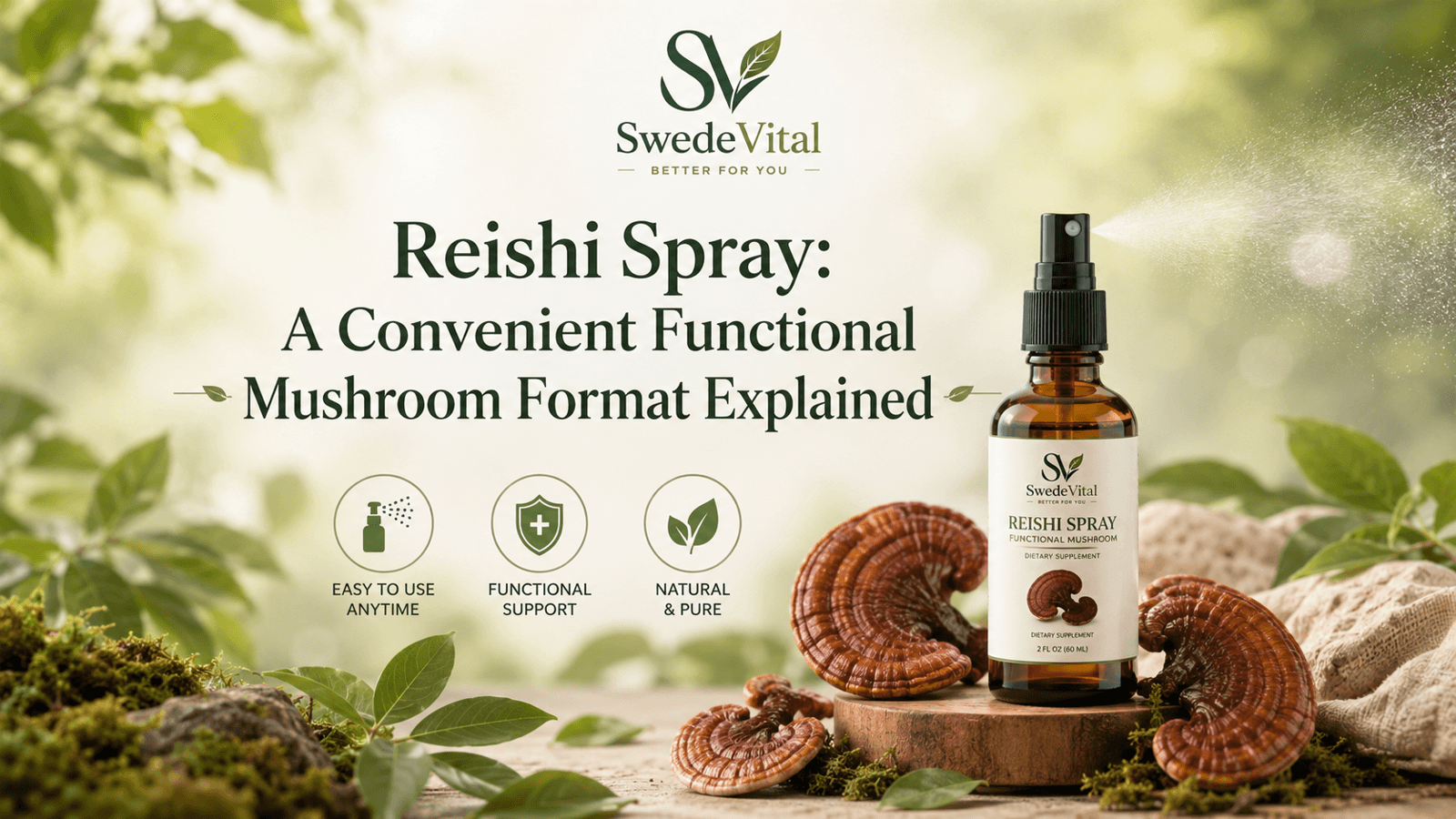
Reishi Spray: A Convenient Functional Mushroom Format Explained

SwedeVital Authority Engine™
SwedeVital
In short
A Reishi spray is a liquid extract of the reishi mushroom that uses dual extraction to capture both water‑soluble beta‑glucans and alcohol‑soluble triterpenes, delivered via a pump for quick, sublingual dosing.
- Reishi spray delivers concentrated mushroom benefits in a portable, sublingual format using dual extraction for full-spectrum potency.
A Reishi spray is a concentrated liquid extract of the reishi mushroom (Ganoderma lucidum) delivered from a compact pump bottle, usually sprayed under the tongue or into a drink. It packages one of the most storied functional mushrooms into a portable, water-free format built for modern, on-the-go routines. For retailers it is an approachable entry point into the functional-mushroom category; for shoppers it is one of the simplest ways to turn an occasional supplement into a daily habit.
This primer explains what a Reishi spray actually is, how it is made, how it compares with capsules, gummies and powders, what reishi has traditionally been used for and studied for, and how a category manager can judge quality before listing one. Throughout, health-related statements are kept deliberately evidence-led: functional mushrooms are food supplements, not medicines.
What is a Reishi spray?
A Reishi spray is reishi in liquid form. The mushroom's active compounds are extracted, concentrated and suspended in a carrier so that a metered pump delivers a small, consistent dose. Most sprays are designed for sublingual use — a couple of sprays held briefly under the tongue — or for adding to water, coffee, tea or a smoothie. The appeal is practical: nothing to swallow whole, no measuring spoons, no water required, and a bottle small enough for a bag or desk drawer.
Reishi itself is sometimes called the "mushroom of immortality" in traditional East Asian herbalism, where it has been used for centuries as a tonic. It is prized for its bitter, woody character and is one of the most recognisable names in the wider functional-mushroom family that also includes lion's mane, cordyceps and turkey tail. The spray format simply meets today's expectation that a daily wellness product should be quick, portable and low-friction.
How a quality Reishi spray is made: dual extraction
Reishi's reputation rests on two broad groups of compounds, and importantly they are not both soluble in the same medium. This is why serious manufacturers use dual extraction.
- Beta-glucans and other polysaccharides are water-soluble and are drawn out with a hot-water extraction.
- Triterpenes (including the bitter ganoderic acids characteristic of reishi) are largely alcohol-soluble and need an alcohol extraction to be captured.
A dual-extract spray combines both processes so the finished liquid reflects the fuller spectrum of the mushroom rather than just one fraction. A water-only or alcohol-only product may be cheaper to produce but leaves part of the mushroom behind. The other quality fork is the raw material itself: an extract made from the fruiting body of the mushroom is generally regarded as more desirable than one grown on grain (mycelium-on-grain), because the latter can carry residual starch that dilutes the active content. None of this guarantees an outcome for any individual, but it does determine whether a shopper is buying genuine concentrated reishi or mostly filler.
Reishi spray vs capsules, gummies and powder
The best format is the one a customer will actually use every day. Each has honest trade-offs, and a well-merchandised range often carries more than one because different shoppers want different things.
Reishi spray
Strengths: highly portable, no water needed, fast to use, easy to build into a routine, and the sublingual route bypasses the "another pill to swallow" objection. Trade-offs: reishi is genuinely bitter, so an unflavoured spray tastes earthy; dosing is per-spray rather than a single fixed capsule; and a small bottle holds fewer total servings than a large powder tub.
Capsules
Strengths: tasteless, precise and familiar; ideal for shoppers who dislike flavour and want a fixed daily amount. Trade-offs: requires water, feels like "taking a supplement", and offers no flexibility to adjust the amount.
Gummies
Strengths: pleasant, treat-like and excellent for habit formation. Trade-offs: usually contain some sugar or sweetener, and the extract load per gummy is often lower than a concentrated spray or capsule.
Powder
Strengths: the most cost-effective per serving and flexible for coffee, lattes and cooking. Trade-offs: the least portable, needs mixing, and reishi's bitterness is most noticeable here unless it is blended with cacao or coffee.
Rule of thumb for buyers: sprays win on convenience and portability, powders win on cost-per-serving, capsules win on precision, and gummies win on enjoyment. The Reishi spray sits precisely where the category is growing fastest — busy consumers who want function without ceremony.
What reishi has traditionally been used for and studied for
Here the language must stay careful. Reishi is a food supplement, and no responsible retailer should imply it treats, prevents or cures anything. What can be said is what tradition and research actually describe.
In traditional East Asian practice, reishi has been used as a calming, restorative tonic, often associated with rest, resilience and general vitality. In modern science, Ganoderma lucidum has been studied for its bioactive compounds — particularly beta-glucans and triterpenes — in areas such as immune modulation, antioxidant activity, sleep quality and the body's response to stress, which is why reishi is frequently described as an adaptogen. It is fair to say research suggests these compounds are of interest and that reishi may support a sense of calm or everyday wellbeing as part of a balanced lifestyle. It is not fair, or lawful in the EU, to promise specific medical results, name diseases, or cite invented dosages or statistics. When in doubt, phrase benefits as "traditionally used for" or "has been studied for" and let the customer draw their own conclusion.
How to choose a quality Reishi spray: a buyer's checklist
Whether you are a category manager assessing a listing or a consumer comparing bottles, the same signals separate a serious product from a commodity one.
- Dual extraction. Look for explicit mention of both water and alcohol extraction, so beta-glucans and triterpenes are both present.
- Fruiting body, not grain. Prefer extracts made from the reishi fruiting body over mycelium grown on grain.
- Extract ratio or standardisation. A stated extract ratio (for example a concentrated multi-to-one extract) or a beta-glucan reference shows the maker knows their potency, without over-claiming.
- Clean carrier and ingredient list. Check what the extract is suspended in and whether flavourings, sweeteners or preservatives are added; shorter is usually better.
- Third-party or in-house testing. Testing for heavy metals and contaminants matters because mushrooms concentrate what they grow in.
- Clear, compliant labelling. Servings per bottle, per-spray amount, storage and an honest, non-medical description of use.
- Traceable, EU-compliant sourcing. Documented origin and food-supplement compliance protect both retailer and shopper.
A product that answers all seven is one a retailer can stand behind. Any that are missing are simply questions to ask the supplier before listing.
Who a Reishi spray is for
Understanding the shopper helps buyers position the product and helps consumers decide if it fits. A Reishi spray tends to suit:
- Convenience-first wellness shoppers who want a daily ritual that takes seconds and travels well.
- Pill-averse customers who dislike swallowing capsules but still want a functional mushroom.
- Evening wind-down routines, given reishi's traditional association with calm and rest.
- Curious first-timers exploring functional mushrooms who want a low-commitment, small-format entry point before buying a large tub.
- Stackers who already use lion's mane for focus or cordyceps for energy and want to add reishi to a routine without extra pills.
As with any supplement, anyone pregnant, breastfeeding, taking medication or managing a health condition should consult a healthcare professional first, and a spray is best treated as a complement to a balanced diet rather than a substitute for one.
Retail and private-label considerations
For buyers and private-label partners, the Reishi spray has structural advantages beyond the shelf. Its small footprint makes it ideal for counter and impulse placement, checkout baskets and gifting bundles. It is a natural cross-sell alongside other functional mushrooms and everyday wellness lines, letting a store build a coherent "functional mushroom" or "calm and sleep" fixture rather than a single lonely SKU. And because the format is inexpensive to try, it lowers the barrier for shoppers new to the category — a helpful acquisition tool for the wider range.
SwedeVital produces reishi and other functional-mushroom formats — capsules, dual-extract sprays and gummies — as branded and private-label options, which lets a retailer match format to audience across a single supplier relationship. The strategic point is not the SKU but the fixture: a spray is often the first product a curious customer picks up, and a good one earns the trust that sells the rest of the category. Merchandised honestly, with compliant claims and a quality extract behind it, a Reishi spray is a small bottle that does a lot of work.
Frequently asked questions
What is a Reishi spray used for?
It is a convenient way to take reishi mushroom extract daily. Reishi has traditionally been used as a calming, restorative tonic and has been studied for compounds linked to immune modulation, antioxidant activity and the body's response to stress. It is a food supplement to support a balanced lifestyle, not a treatment for any condition.
How do you use a Reishi spray?
Most sprays are used sublingually — a few pumps under the tongue, held briefly before swallowing — or added to water, coffee, tea or a smoothie. Follow the serving guidance on the specific product label, as per-spray amounts differ between brands.
Is a Reishi spray better than capsules or gummies?
Better depends on the person. A spray wins on portability and speed and needs no water; capsules win on precise, tasteless dosing; gummies win on enjoyment; powders win on cost per serving. The best format is the one a customer will use consistently.
Does a Reishi spray taste bitter?
Reishi is naturally bitter and woody, so an unflavoured spray will taste earthy. Some products add natural flavour to soften this, and taking the spray in a drink such as coffee or a smoothie also masks the bitterness.
What should I look for in a quality Reishi spray?
Look for dual extraction (water and alcohol), fruiting-body sourcing rather than grain-grown mycelium, a stated extract ratio, a clean carrier, contaminant testing and clear, compliant labelling. Those signals separate a genuine concentrated extract from a diluted commodity product.
Is a Reishi spray safe for everyone?
Reishi is widely used as a food supplement, but it is not suitable for every situation. Anyone pregnant, breastfeeding, taking medication or managing a health condition should consult a healthcare professional before use, and it should complement rather than replace a balanced diet.
Frequently asked questions
What makes a Reishi spray different from other reishi products?+
Reishi spray uses dual extraction to capture both beta‑glucans and triterpenes, is delivered sublingually, and offers a portable, water‑free format that’s easy to incorporate into daily routines.
How do I know if a Reishi spray is high quality?+
Look for dual extraction, fruiting body sourcing (not mycelium‑on‑grain), and clear labeling of active compounds. A reputable brand will mention both water‑ and alcohol‑based extracts.
Can I use a Reishi spray with my existing supplements?+
Yes, it can be added to drinks or taken under the tongue. Just be mindful of dosage—each spray delivers a measured dose, so adjust accordingly if you’re also taking capsules or powders.
Is a Reishi spray safe for daily use?+
Reishi is a food supplement, not a medicine. Daily use is generally considered safe, but consult a healthcare professional if you have medical conditions or are taking prescription drugs.
What benefits can I expect from a Reishi spray?+
Traditional use and modern research suggest reishi may support calmness, resilience, immune modulation, antioxidant activity, and sleep quality as part of a balanced lifestyle.
See the full SwedeVital range
Every line, every format, and what it takes to stock them — sent to you now, before we open for orders on 1 January 2027.
Written by
SwedeVital Authority Engine™
Last updated
2 September 2026