
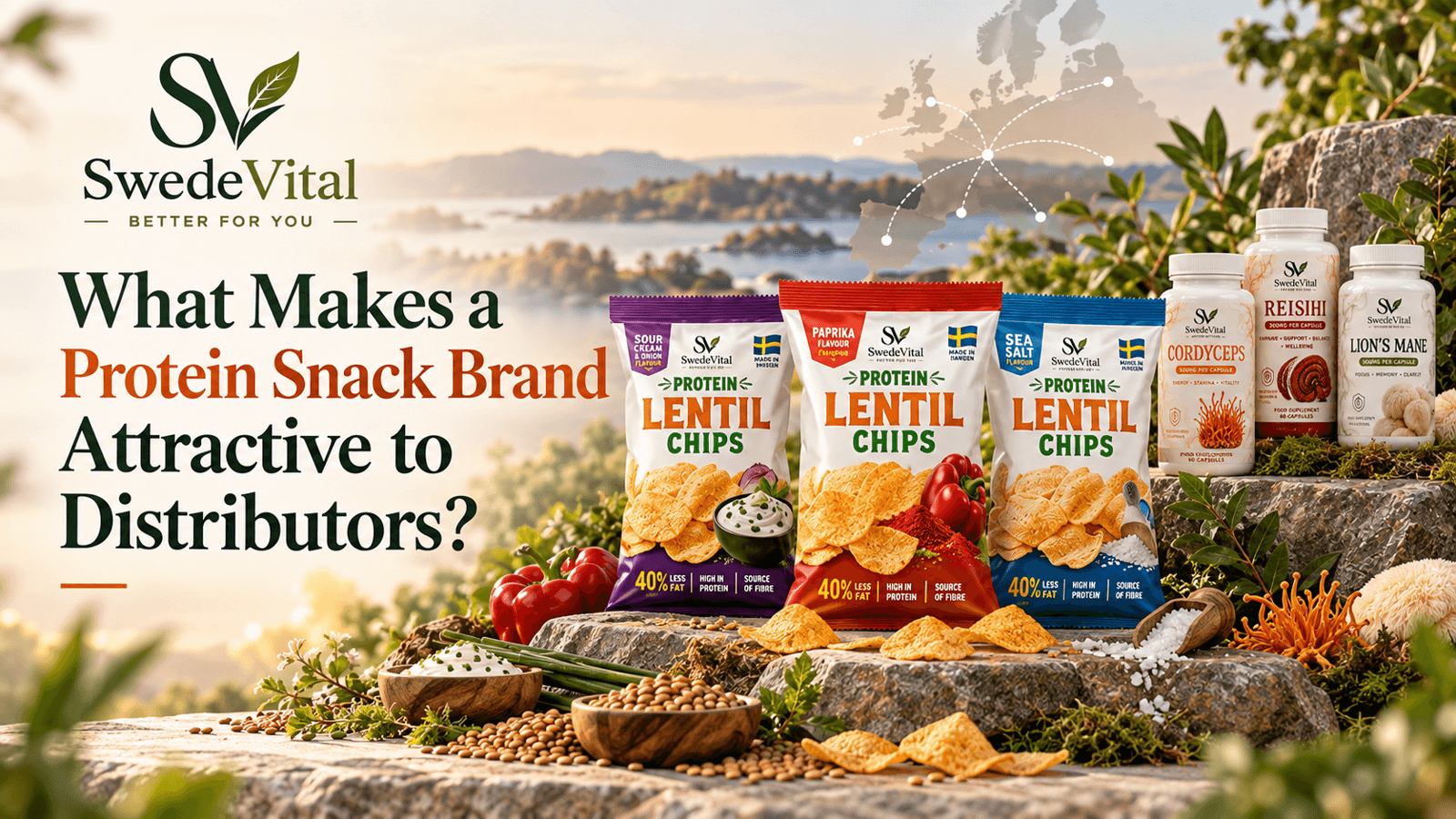
What Makes a Protein Snack Brand Attractive to Distributors?

SwedeVital Authority Engine™
SwedeVital
In short
Distributors choose protein snack brands that offer predictable margins, reliable supply, clean compliance, and repeatable sales, not just good taste. They look for transparent pricing, strong documentation, and a clear better‑for‑you proposition that drives repeat purchase.
- Distributors value protein snack brands that deliver predictable margins, reliable supply, clean compliance, and repeatable sales.
Protein snack brands for distributors earn shelf space and long-term contracts when they solve a buyer's real problem: predictable margin, dependable supply, clean compliance and products that actually re-order. A brand is not attractive because it tastes good; it is attractive because it moves off the shelf, ships on time, and is easy to sell into a category without creating risk for the person who stocked it.
For category managers and distributors weighing what to add next, the decision is rarely about a single hero product. It is about whether a supplier can be a reliable partner across dozens of stores, seasons and price negotiations. This article breaks down exactly what buyers assess, the trade-offs involved, and a practical readiness checklist you can use on either side of the table.
What makes protein snack brands for distributors attractive
When distributors look at protein snack brands, they are underwriting a relationship, not a flavour. The core question is whether the brand will generate reliable sell-through at an acceptable margin with minimal operational friction. In practice, that breaks into a handful of weighted criteria: unit economics, product velocity, supply reliability, regulatory documentation, and how well the range fits an existing category plan.
It helps to understand where protein snacks sit relative to adjacent categories. Protein powder is a high-volume, planned-purchase product: shoppers research it, buy in bulk, and it lives in a supplements aisle. Protein snacks behave differently. They are frequently impulse or grab-and-go purchases, sold in convenience, grocery and foodservice settings, with faster repeat rates and smaller basket value. A distributor evaluating a protein snack range is therefore looking for velocity and repeatability, not the deep, considered demand that drives powder sales. Knowing which game you are in changes how you pitch the range.
Margin, pricing structure and unit economics
Margin is the first filter, and it is more nuanced than a single percentage. Distributors need a landed cost that leaves room for their own margin, the retailer's margin, promotional funding and freight, while still hitting a shelf price shoppers will accept. A brand that looks cheap ex-works can become unworkable once pallet configuration, case pack, freight and duty are added.
The strongest suppliers present transparent, tiered pricing and can explain the whole chain from factory gate to shelf. Buyers will want to see:
- Clear case and pallet economics — units per case, cases per layer, layers per pallet, and weight, so logistics cost per unit is predictable.
- Volume tiers that reward growth without punishing a cautious first order.
- Promotional flexibility — the ability to fund an introductory deal or a multibuy without eroding the entire relationship.
- Price stability — a credible view on how input costs (protein sources, packaging, energy) may move, so the buyer is not repricing every quarter.
The trade-off to be honest about: the lowest price rarely wins. A slightly higher cost with dependable supply, strong artwork and category support usually delivers better net margin than a cheap product that stocks out or sits unsold. Distributors have learned this the hard way, so a brand that leads with price alone often signals it has little else to offer.
Product quality and formulation that sells through
Sell-through is the metric that keeps a listing alive. A product can clear the first purchase order on novelty, but it only survives a range review if shoppers come back. That makes formulation a commercial decision, not just an R&D one.
Buyers increasingly favour ranges with a clear better-for-you proposition: recognisable ingredients, a meaningful protein contribution, and a clean label without a wall of additives. Plant-based options — for example protein lentil chips, protein bites and protein bars — broaden the addressable shopper base because they suit flexitarian, vegetarian and allergen-conscious customers alongside dedicated sports buyers. Where a functional-wellness angle is present, such as ingredients associated with focus or recovery, claims must stay evidence-led and non-committal. Responsible language matters: research suggests certain functional ingredients may support aspects of wellbeing, but a buyer will discount any supplier who promises guaranteed outcomes, because those claims create regulatory exposure they do not want to inherit.
Taste and texture still decide repeat purchase, so samples matter. A distributor will typically want to trial products internally and, ideally, run a limited placement before committing to a wide rollout. A brand confident enough to encourage that testing signals it expects to win on merit.
Certifications, compliance and documentation
Nothing stalls a listing faster than missing paperwork. For food and wellness products crossing borders in Europe, distributors expect a complete documentation pack before they will progress a deal. Incomplete files are read as operational risk, and buyers will simply move to the next supplier rather than chase you for a spec sheet.
A well-prepared brand can produce, without delay:
- Full ingredient specifications and up-to-date nutrition information per product.
- Allergen declarations and, where relevant, statements on cross-contamination controls.
- Applicable food-safety certification for the manufacturing site and evidence of quality management.
- Correct, market-ready labelling that meets the destination country's language and regulatory requirements.
- Shelf-life data, storage conditions and batch traceability.
Getting this right is also a trust signal. A supplier whose documentation is orderly on day one tends to be the supplier who handles a recall query, a customs hold or a labelling change calmly later on. That reliability is worth a great deal to a distributor whose reputation with retailers is on the line.
Supply reliability and lead times
Once a product sells, the fastest way to lose the listing is to run out of it. Out-of-stocks cost the retailer sales, annoy shoppers, and make the distributor look unreliable to their own accounts. Consequently, supply chain credibility often outweighs a marginal price advantage.
Buyers probe this directly. They ask about production capacity, realistic lead times, safety stock, and what happens when demand spikes after a promotion. They want to know whether the manufacturer controls its own production or depends on a single contract site, and how a raw-material shortage would be handled. A brand that can answer these questions concretely — with lead times it actually hits — is far more attractive than one making optimistic promises. It is better to quote an honest four-week lead time and meet it than to promise two weeks and disappoint.
Brand story, merchandising and category fit
Distributors sell into buyers who think in categories and planograms, not individual SKUs. A range is easier to place when it tells a coherent story and comes with the assets to merchandise it well. This is where a manufacturer with a genuine origin — for instance a Swedish maker with a clear better-for-you positioning — has an advantage, provided the story is real and not marketing veneer.
Practical support that makes a brand easier to sell includes high-quality product photography, clear on-pack hierarchy, ready-made shelf and display units, and simple guidance on where the range fits the aisle. A tidy, logical range architecture — a snacking line and a functional-wellness line that each make sense on their own — lets a buyer choose an entry assortment and expand later. The trade-off is focus versus breadth: too few SKUs and the brand cannot hold a section; too many and the buyer is overwhelmed and worried about slow movers. The best pitches recommend a starter set with a clear rationale rather than dumping the entire catalogue on the table.
Private label: how protein snack brands for distributors flex to the buyer
For many buyers, the most attractive brands are the ones that can flex to their model. Some want a branded range they can champion; others want private-label or white-label production to build their own equity and protect margin. A manufacturer able to offer both, with transparent minimum order quantities and a straightforward development process, widens the number of deals it can do.
Flexibility should be scoped honestly. Private label typically involves higher minimums, longer first-run lead times and shared development work on recipe, format and artwork. A supplier who is upfront about those realities — rather than promising a frictionless custom product at tiny volumes — builds more durable partnerships. The same applies to format flexibility: offering a product as a snack, and adjacent wellness formats such as capsules, sprays or gummies, lets a distributor assemble an assortment tuned to its channel without juggling multiple suppliers.
A distributor-readiness checklist
Whether you are a brand preparing to pitch or a distributor evaluating one, the same short checklist surfaces most of the risk quickly:
- Unit economics — is landed cost, case/pallet configuration and shelf price margin-viable across the chain?
- Sell-through evidence — is there a credible reason shoppers will repeat-buy, and can the brand support a trial?
- Documentation pack — are specs, allergens, certification and market-ready labelling complete today?
- Supply reliability — are lead times, capacity and contingency realistic and stated plainly?
- Category support — are photography, display assets and a recommended starter assortment ready to go?
- Flexibility — can the supplier support branded and private-label routes with honest minimums?
- Partnership signals — is communication fast, transparent and consistent from the first conversation?
The brands distributors keep are the ones that reduce risk: reliable margin, reliable supply, reliable paperwork, and a partner who does what they said they would.
Attractiveness, in the end, is the sum of these parts. A protein snack range wins distribution not by being the loudest or the cheapest, but by being the easiest and safest to sell — from the first sample through to the tenth reorder. Suppliers such as SwedeVital that pair a focused better-for-you snacking line with a complementary functional-wellness range, and back it with clear documentation and private-label options, are structured around exactly what buyers say they need. The brands that internalise that reality are the ones that keep their shelf space.
Related reading
- buyer's guide for distributors
- choosing a European supplier
- supplier criteria for distributors
- scaling a protein snack brand
- protein snack trends for buyers
- differences between protein and traditional snacks
Sources
Frequently asked questions
What is the most important factor for distributors when choosing a protein snack brand?+
Predictable margin and reliable supply are the top priorities, followed by clean compliance and repeatable sales.
How should a brand present its pricing to distributors?+
Brands should offer transparent, tiered pricing with clear case and pallet economics, volume tiers, promotional flexibility, and price stability.
Why is compliance documentation critical for distributors?+
Missing paperwork signals operational risk; complete ingredient specs, allergen declarations, certifications, and labelling meet regulatory requirements and build trust.
What makes a protein snack range attractive for repeat purchase?+
A clear better‑for‑you proposition, clean labels, plant‑based options, and evidence‑led functional claims drive repeat purchase.
What is a readiness checklist for protein snack brands?+
Ensure unit economics, product velocity, supply reliability, regulatory documentation, and category fit are all addressed before pitching to distributors.
See the full SwedeVital range
Every line, every format, and what it takes to stock them — sent to you now, before we open for orders on 1 January 2027.
Written by
SwedeVital Authority Engine™
Last updated
6 October 2026