
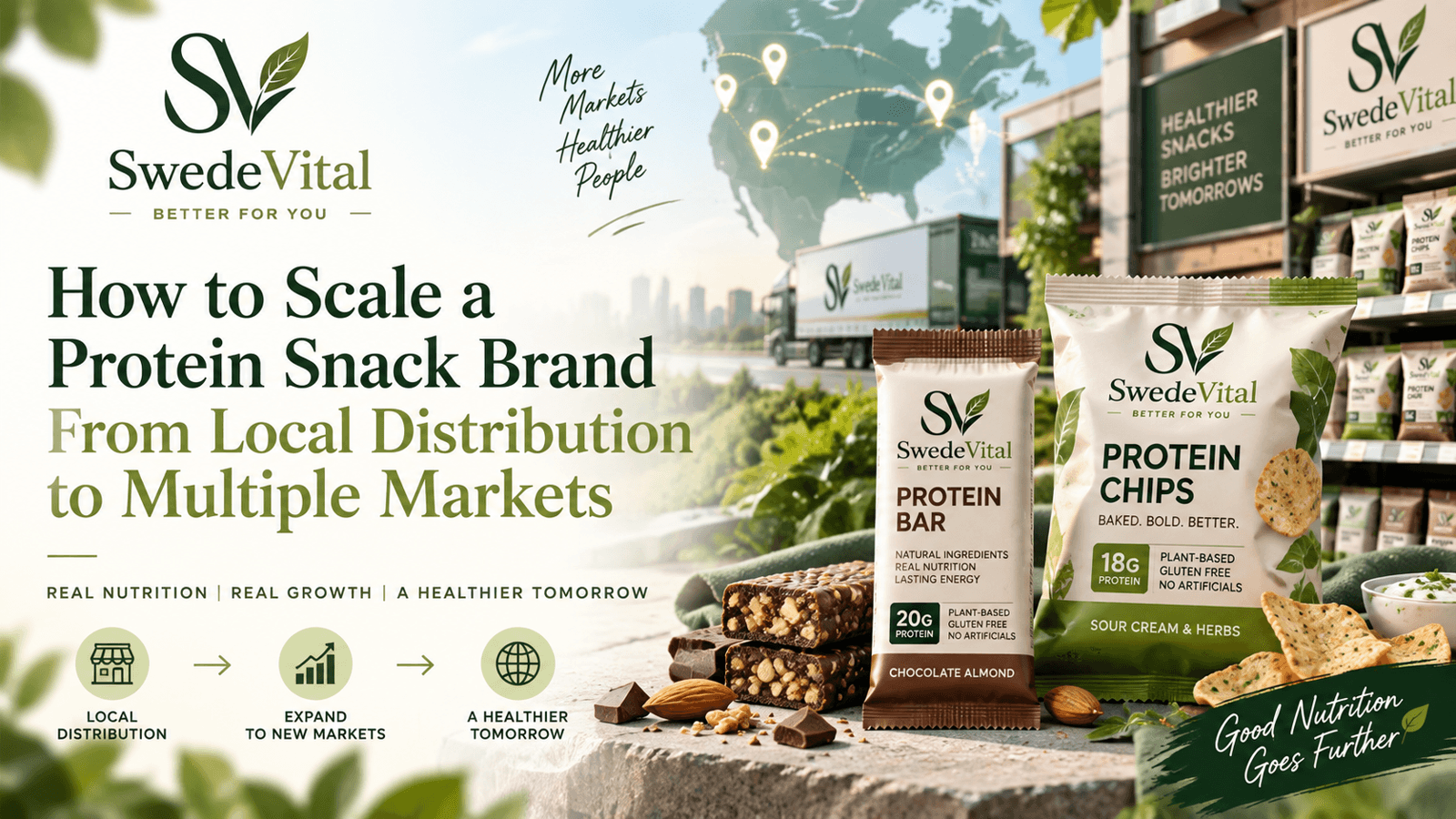
How to Scale a Protein Snack Brand From Local Distribution to Multiple Markets

SwedeVital Authority Engine™
SwedeVital
In short
To scale a protein snack brand, first tighten unit economics and retailer relationships locally, then expand deliberately—one adjacent market at a time—using the distribution route that best matches your margin, shelf‑life, and service capacity.
- Scale a protein snack brand by mastering depth, breadth, and geography in sequence, modeling landed costs, and choosing the right channel mix.
To scale snack distribution from one local market to several, tighten your unit economics and retailer relationships at home first, then expand deliberately - one adjacent market at a time - using the route to market (distributor, retail-direct or private label) that matches your margin, shelf-life and service capacity. Scaling is not "sell everywhere at once"; it is repeating a proven, profitable playbook in markets you can actually service.
For a protein snack brand, the temptation after a strong local launch is to say yes to every buyer, region and channel that shows interest. That is how promising brands run out of cash. This guide is written for founders and commercial leads deciding how to grow, and for the retail category managers and distributors evaluating whether a brand is ready to sit on their shelves. It focuses on the operational and commercial decisions - not motivational advice.
What scaling distribution actually means
Distribution scaling has three distinct layers, and conflating them is the most common early mistake. Depth is selling more through the doors you already have. Breadth is adding more doors in the same market. Geography is entering new markets or countries. Each layer has different costs, risks and skills.
Depth is almost always the cheapest growth and the strongest signal to future buyers: it proves genuine consumer pull-through, not just a one-off listing. Breadth tests your ability to service more accounts without your fill rate or freshness slipping. Geography is the most expensive and the most often rushed. The disciplined sequence is depth, then breadth, then geography - and to resist geography until the first two are demonstrably working.
Prove the model locally before you try to scale snack distribution
Buyers in a new market will ask one question in different ways: "Does this actually sell?" You need evidence before you spend on expansion. Before adding markets, confirm a few things are true and, ideally, documented:
- Repeat velocity: units sold per store per week, and whether reorders are happening without you pushing them.
- A defensible reason to exist: a clear consumer need your protein snack answers - convenient protein, cleaner ingredients, or a format gap on shelf.
- Reliable supply: you can fulfil reorders on time, at quality, with consistent shelf-life on arrival.
- Healthy contribution margin after trade spend, not just gross margin on the spec sheet.
If you cannot show real rate of sale in your home market, a distributor abroad is not a growth engine - it is a warehouse where your stock ages. Fix depth first.
Choose the right route to market
There is no single correct channel; there is the channel that matches your margin, control needs and service capacity. The main options for a snack brand each carry a clear trade-off.
Distributors and wholesalers
A distributor gives you reach, logistics and existing retailer relationships fast. The cost is margin and distance from the shopper - you lose some control over pricing, promotion and how your story is told. Distributors are strongest when you already have pull demand they can service; they are weakest as a substitute for demand you have not yet created.
Retail-direct
Selling directly to a chain keeps more margin and control, but demands you handle EDI, service levels, promotional planning and often direct-store or centralized delivery. It suits brands with the operational maturity to meet a retailer's compliance and fill-rate expectations.
Private label and contract manufacturing
Producing under a retailer's or partner's brand can fund your factory, smooth production runs and open volume that your own brand cannot yet reach. The trade-off is thinner margin and less brand equity. Many manufacturers - SwedeVital among them - run a branded range alongside private-label partnerships precisely because the two balance cash flow and growth. Treat private label as a deliberate capacity and cash strategy, not a fallback.
Rule of thumb: use distributors to buy reach, retail-direct to keep margin and control, and private label to fund capacity. Most scaling brands end up with a blend, not a single channel.
The unit economics that decide whether you can scale
Expansion multiplies whatever economics you already have. If a market is marginal at home, it will usually be worse once you add freight, duties, a distributor margin and local trade spend. Before entering any new market, model the landed cost and the full margin waterfall honestly.
- Cost to serve: freight, pallet configuration, minimum order quantities and how far product travels before it reaches shelf.
- Shelf-life on arrival: protein snacks and functional products have finite freshness. Long transit erodes saleable life and raises the risk of markdowns and returns.
- The margin waterfall: list price minus distributor margin, retailer margin, listing fees, promotional support and expected wastage. What remains is your real contribution.
- Working capital: new markets often mean longer payment terms and more stock in transit. Growth consumes cash before it returns it.
A simple discipline: if you would not be comfortable running the market at a modest promotional depth for a full year, you are not ready to enter it. Protect freshness and cash, and you protect the brand.
Sequence your markets by adjacency, not ambition
The order in which you enter markets matters more than the total number you eventually reach. A common failure is chasing the largest or most prestigious market first because it looks impressive, then discovering the cost to serve, the competitive intensity and the compliance burden are all highest there. Pick your next market for how closely it resembles a market you already win in, and how easily you can service it.
Score candidate markets against a short, honest set of questions: How far does product travel, and what does that do to freshness and freight? How similar are the shopper, the retail structure and the regulatory regime to a market you have already cracked? Do you have a credible route to market partner ready, or are you starting cold? Is the working capital requirement one you can absorb if payment terms stretch? The best next market is usually the boring adjacent one - close, similar and serviceable - not the biggest flag on the map.
Sequencing this way compounds. Each adjacent win makes the following market a shorter step, because your playbook, your compliance templates and your supply chain are already tuned for something close to it. Brands that leapfrog into distant, dissimilar markets tend to rebuild the playbook from scratch each time and stall.
Localize the product, claims and compliance
Crossing a border is a regulatory and cultural exercise, not just a logistics one. In the EU, food labelling, allowed nutrition and health claims, and language requirements are governed by strict rules, and functional-wellness products such as mushroom extracts, creatine or magnesium can face additional scrutiny depending on how they are categorized in each country.
Get the boring things right early: compliant ingredient and allergen labelling, correct nutrition declaration, market-appropriate claims, and translated packaging that still reads as premium. Health and functional benefits should be framed carefully - evidence-led and non-committal ("research suggests", "may support") rather than promising guaranteed outcomes. Buyers and regulators both punish overclaiming, and one compliance failure can cost you a listing you worked months to win.
Win the buyer, not just the consumer
A category manager is not buying a snack; they are buying incremental sales, a coherent range and a supplier who will not create problems. To earn a listing, lead with the retailer's economics rather than your own enthusiasm.
- Range logic: show where you fit in the better-for-you set and what shopper you bring in - ideally an incremental one, not a switch from an existing line.
- Rate of sale from comparable markets as proof the product moves.
- A promotional and launch plan that drives trial without training shoppers to only buy on deal.
- Operational credibility: lead times, fill rate, minimum orders and how you handle short-dated or damaged stock.
Buyers also field constant requests for healthy snack ideas and better-for-you formats from their own shoppers; a supplier who frames the category clearly - who eats this, when, and why it grows the basket - is far easier to say yes to than one who only pitches a single SKU. Sell the shelf, not the product.
A phased checklist to scale snack distribution
Use this as a gate at each stage - do not advance until the previous phase is genuinely true.
- Prove depth locally: stable repeat velocity, reliable reorders and positive contribution margin after trade spend.
- Stabilize supply: consistent quality, dependable lead times and shelf-life you can guarantee on arrival.
- Pick one adjacent market: choose for reachability and similarity, not glamour, and model its full landed cost and margin waterfall.
- Choose the matching route to market: distributor, retail-direct or private label, based on margin, control and service capacity.
- Localize fully: compliant labelling, translated packaging and market-appropriate claims signed off before the first pallet ships.
- Launch with a plan and a floor: defined trial support, agreed service levels and a minimum performance you will hold the listing to.
- Review, then repeat: measure real rate of sale, fix the playbook, and only then add the next market.
Scaling well is boring by design. The brands that expand successfully treat each new market as a repeatable, measurable playbook rather than a leap of faith - and they walk away from doors they cannot service profitably.
Frequently asked questions
Short, direct answers to the questions buyers and founders ask most when planning to scale snack distribution.
Related reading
- protein snack trends
- protein snacks vs traditional snacks
- protein snack quality factors
- taste matters as much as nutrition
- private‑label protein chips strategy
Sources
- Protein Snack Market Growth | Size & Trends 2035
- Study on the protein snack phenomenon | Chomps
- Protein Snacks Market Size, Share & 2031 Trends Report
- Private label is “transitioning and getting much more sophisticated” – Snak King CEO Michael Axelrod discusses snack lea
- CPG Trade Spend: Benchmarks and How It Works — Scout
- Global Protein Snack Market Competitive Environment 2026-2033 | Stats N Data
Frequently asked questions
What is the first step to scaling a protein snack brand?+
The first step is to tighten unit economics and retailer relationships in your home market, proving depth and breadth before expanding geographically.
Which distribution channel should I choose for a new market?+
Choose the channel that aligns with your margin, control needs, and service capacity: distributors for reach, retail‑direct for margin and control, and private label for cash flow.
How do I decide which new market to enter next?+
Select adjacent markets that closely resemble your current winning market in terms of shopper behavior, retail structure, and regulatory regime, and score them on cost to serve and freshness impact.
Why is geography the most expensive layer of scaling?+
Geography involves higher freight, duties, distributor margins, local trade spend, and longer payment terms, all of which increase costs and risk.
What should I model before entering a new market?+
Model the landed cost, full margin waterfall, freight, shelf‑life on arrival, and working capital requirements to ensure the market is profitable before entry.
See the full SwedeVital range
Every line, every format, and what it takes to stock them — sent to you now, before we open for orders on 1 January 2027.
Written by
SwedeVital Authority Engine™
Last updated
17 September 2026