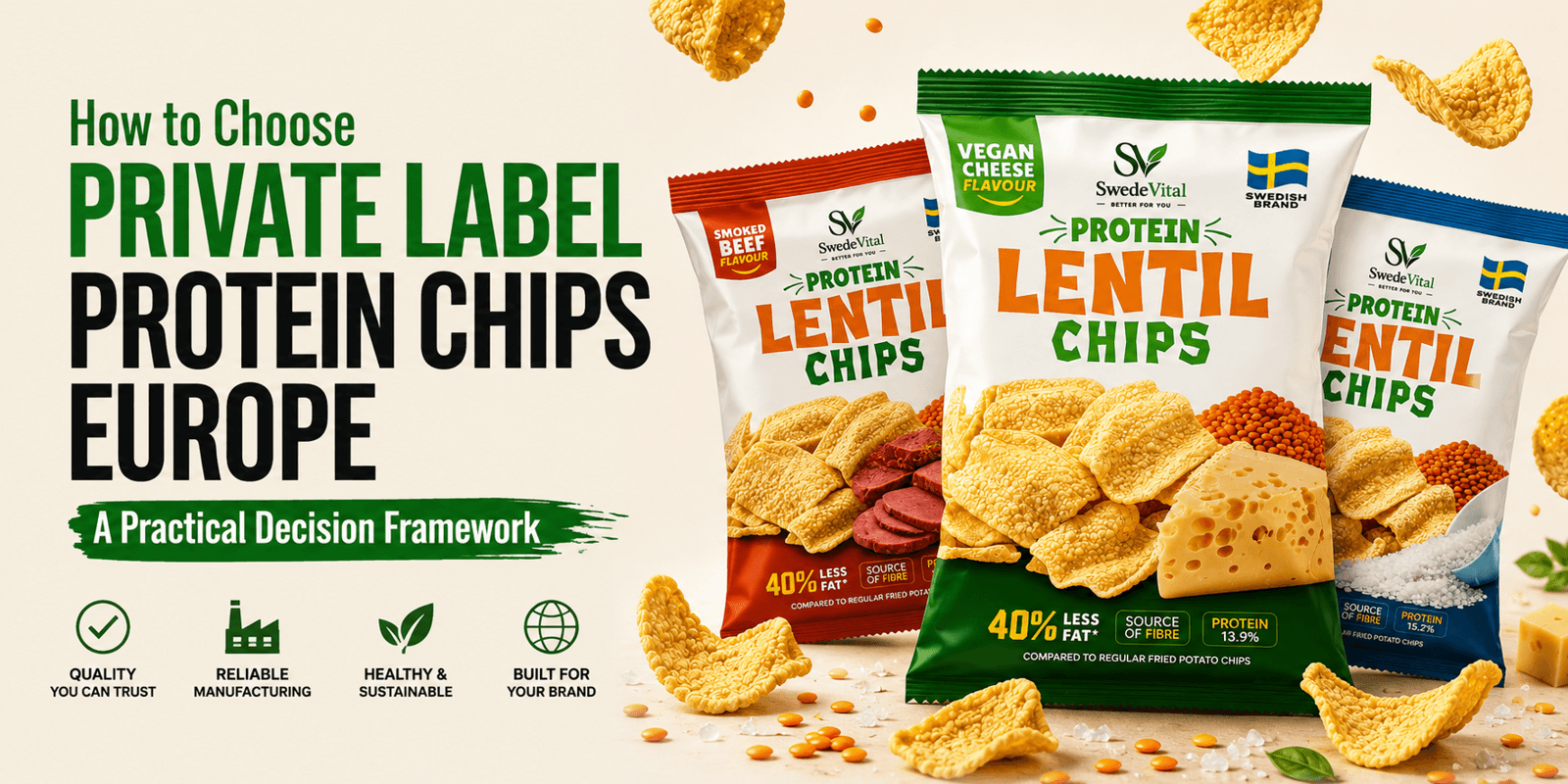
How to Choose Private Label Protein Chips Europe: A Practical Decision Framework

SwedeVital Authority Engine™
SwedeVital
In short
To choose private‑label protein chips in Europe, start by defining a detailed product specification (protein source, flavor, texture, allergens), map supply‑chain options (in‑house vs. contract manufacturers), verify technical capabilities and certifications, build a comprehensive cost model, assess shelf life and packaging, ensure regulatory compliance across EU member states, pilot launch with c
- Choosing private‑label protein chips in Europe involves defining specs, evaluating supply chains, ensuring quality and compliance, analyzing costs, testing shelf life, piloting, and scaling up.
Choosing the Right Private‑Label Protein Chips in Europe: A Practical Decision Framework
When a retailer or brand wants to add protein‑rich, low‑carb snacks to its shelf, the first question is not “how much protein?” but “who can deliver the right product mix at scale while keeping quality and cost under control.” In the European market, private‑label protein chips have surged from niche curiosity to mainstream staple, with a projected market value of USD 5.07 billion by 2034 (18.16% CAGR). The challenge is navigating a crowded supply chain that spans ingredient sourcing, formulation, regulatory compliance, and distribution.
Step 1: Define the Product Profile You Need
Start with a clear specification sheet. Ask yourself:
- Protein source: whey, pea, soy, or a blend?
- Flavor family: savory (sea salt, sour cream & onion), meat‑inspired (smoked beef), or sweet (vegan cheese, chocolate).
- Texture and crunch level: crisp wafers vs. thicker chips.
- Allergen profile: gluten‑free, nut‑free, dairy‑free?
- Target consumer segment: athletes, weight‑watching shoppers, or general health‑conscious consumers.
Your specification will filter suppliers that can meet your niche. For example, a brand targeting vegan athletes would need pea‑based chips with no dairy by‑products and a high protein density (≥20 g per 50 g serving).
Step 2: Map the Supply Chain Landscape
The European private‑label space is dominated by three key players:
- Manufacturers with in‑house ingredient sourcing. These firms, such as Newon Food, control the entire process from protein extraction to final packaging. They offer tight quality control but may have higher minimum order quantities (MOQs).
- Contract manufacturers that source ingredients externally. Companies like BARIATRIX Nutrition specialize in protein chips and can flexibly mix ingredient suppliers to meet cost targets.
- Private‑label bars manufacturers with diversified product lines. Firms such as Ravensbergen Food can pivot between bars and chips, offering bundled pricing for multi‑product portfolios.
Assess each model against your volume forecast. High‑volume brands benefit from in‑house sourcing; mid‑tier brands may prefer contract manufacturers that offer lower MOQs and faster turnaround.
Step 3: Evaluate Technical Capabilities and Quality Assurance
A robust quality system is non‑negotiable. Look for:
- CERTIFICATIONS: ISO 22000, HACCP, or EU organic certification if you target premium segments.
- Product testing: Independent lab results for protein content, allergen screening, and microbiological safety.
- Process validation: Documentation of extrusion parameters (temperature, pressure) that produce consistent crunch without over‑drying.
Request a sample batch and conduct your own sensory panel. Pay attention to flavor retention after packaging—some suppliers use vacuum sealing or nitrogen flushing to preserve crispness for up to 12 months.
Step 4: Cost Analysis Beyond the Unit Price
The unit price is only one side of the equation. Build a cost model that includes:
- Ingredient cost volatility: Protein prices can swing 10–15% annually; negotiate fixed‑price contracts if possible.
- Packaging and labeling: Custom foil pouches vs. standard PET bags affect both cost and shelf life.
- Logistics: EU customs, warehousing, and last‑mile delivery can add 5–10% to the landed cost.
- Return policy and warranty: A supplier that offers a full refund for quality issues reduces risk.
Create a detailed spreadsheet that tracks each line item over a projected three‑year horizon. This will expose hidden costs such as seasonal ingredient shortages or packaging material price spikes.
Step 5: Assess Shelf Life and Distribution Fit
Protein chips are sensitive to moisture migration, which can soften crunch over time. Evaluate the following:
- Moisture barrier integrity: Foil‑lined pouches with a low oxygen transmission rate (OTR) keep chips crisp longer.
- Temperature tolerance: Some formulations degrade above 25 °C; confirm that your distribution network can maintain cooler conditions if needed.
- Retail shelf placement: Chips intended for impulse purchase should have a clear, eye‑catching label that communicates protein content at a glance.
Run a shelf‑life study with the supplier’s packaging to confirm that the product meets your target 12‑month freshness window under typical retail conditions.
Step 6: Regulatory and Labeling Compliance Across Borders
The EU has harmonised food labelling, but nuances exist between member states. Key points:
- Nutrient declaration: Protein must be listed in the nutrition facts panel; for vegan products, a “vegan” claim requires compliance with the EU Vegan Labeling Regulation.
- Allergen declarations: Even trace amounts of soy or dairy trigger mandatory labeling if present.
- Health claims: Claims such as “high in protein” are allowed but must be supported by scientific evidence; avoid unsubstantiated statements that could attract regulatory scrutiny.
Engage a local compliance consultant to audit the label design before final approval. This step prevents costly recalls or market withdrawals later.
Step 7: Pilot Launch and Feedback Loop
Before committing to full‑scale production, run a controlled pilot in a limited number of stores:
- Set clear KPIs: Sales velocity, return rate, customer feedback on taste and texture.
- Collect data systematically: Use point‑of‑sale analytics to capture purchase patterns.
- Iterate quickly: If the pilot reveals a flavor drop or packaging defect, work with the supplier to adjust formulation or pouch design within weeks rather than months.
A successful pilot validates the entire supply chain and gives you confidence that the product will perform at scale.
Step 8: Scale‑Up Strategy and Continuous Improvement
Once the pilot confirms viability, focus on scaling while maintaining quality:
- Production ramp‑up plan: Coordinate with the manufacturer to increase output
Sources
- Europe Protein Chip Market Size, Share & Growth, 2034
- European Union
- How Europe’s proposed labelling rules for plant-based products could impact food businesses – and stifle industry innova
- Protein diversification — strategic risks andopportunities for sustainable food systems
- How PSA Nitrogen Packaging Extends Snack Shelf Life & Boosts Freshness — ARIES PRO
- Effect of Temperature on In Vivo Protein Synthetic Capacity in ...
Related reading
Frequently asked questions
What are the main supply‑chain models for private‑label protein chips in Europe?+
The industry is dominated by three models: manufacturers with in‑house ingredient sourcing, contract manufacturers that source externally, and diversified private‑label bars companies that can pivot between products. Each offers different MOQs, flexibility, and cost structures.
How do I ensure the quality of protein chips from a supplier?+
Look for ISO 22000 or HACCP certifications, independent lab testing for protein content and allergens, documented extrusion parameters, and conduct your own sensory panel on sample batches. Verify packaging methods that preserve crispness.
What regulatory considerations must be addressed when labeling protein chips in the EU?+
Include accurate nutrient declarations, comply with the EU Vegan Labeling Regulation if claiming vegan, list all allergens even trace amounts, and support any health claims like “high in protein” with scientific evidence. Use a local compliance consultant to audit labels.
How can I build an effective cost model for private‑label protein chips?+
Include ingredient price volatility, packaging options (foil pouches vs PET bags), logistics costs (customs, warehousing), and potential warranty or return policies. Track each line item over a multi‑year horizon to uncover hidden expenses.
Why is a pilot launch important before full production?+
A controlled pilot lets you measure sales velocity, return rates, and customer feedback in real retail settings. It allows rapid iteration on flavor or packaging issues, reducing risk when scaling up.
See the full SwedeVital range
Every line, every format, and what it takes to stock them — sent to you now, before we open for orders on 1 January 2027.
Written by
SwedeVital Authority Engine™
Last updated
11 August 2026