
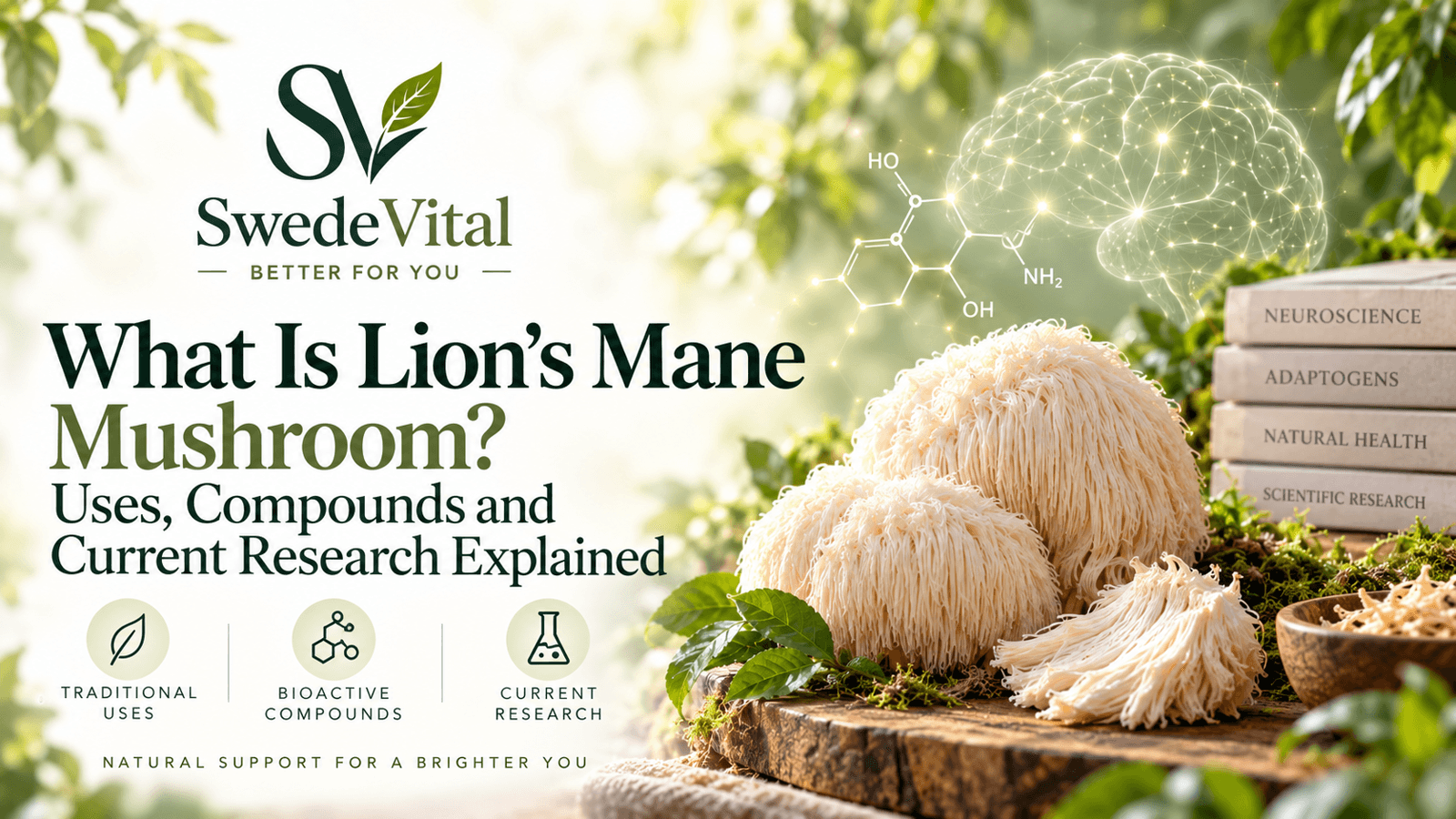
What Is Lion's Mane Mushroom? Uses, Compounds and Current Research Explained

SwedeVital Authority Engine™
SwedeVital
In short
Lion's Mane mushroom (Hericium erinaceus) is a white tooth-fungus whose unique compounds hericenones and erinacines are studied for potential cognitive and nerve-supporting effects, though evidence remains early and claims should be tempered.
- Lion's Mane mushroom contains hericenones and erinacines that may support brain and nerve health, but research is still early and claims should be cautious.
What is Lion's Mane? Lion's Mane (Hericium erinaceus) is an edible mushroom recognised for its cascading, icicle-like white spines that resemble a lion's mane. Prized for centuries in East Asian kitchens and traditional wellness practices, it has become one of the most sought-after "functional" mushrooms, sold today as capsules, powders, dual-extract tinctures, sprays and gummies. It is best known for two families of compounds — hericenones and erinacines — that researchers have studied for their potential effects on the nervous system.
What is Lion's Mane mushroom, exactly?
Lion's Mane is the common name for Hericium erinaceus, a white tooth-fungus that grows on hardwood trees such as oak and beech across the Northern Hemisphere. Instead of a conventional cap and gills, it forms a rounded, shaggy cluster of soft, downward-hanging spines. Other common names include yamabushitake (Japanese), hou tou gu or "monkey head mushroom" (Chinese), and bearded tooth fungus.
Importantly, it is a genuine culinary mushroom, not only a supplement ingredient. Cooked, it has a tender, slightly springy texture and a mild, savoury, seafood-like flavour often compared to crab or lobster, which is why it appears on plant-forward restaurant menus. In the wellness market, however, it is most often concentrated into extracts so that its bioactive compounds can be delivered in a consistent, measurable dose rather than eaten as food.
The signature compounds in Lion's Mane
To understand Lion's Mane you have to understand its chemistry, because that is where most of the research interest sits. Two groups of molecules are more or less unique to this mushroom and are the reason it is studied so intensively:
- Hericenones — found mainly in the fruiting body (the visible mushroom). They have been examined in laboratory settings for how they interact with nerve-signalling pathways.
- Erinacines — concentrated in the mycelium (the root-like network). These are of particular interest to researchers because, in cell and animal models, some appear able to reach relevant tissues.
- Beta-glucans and other polysaccharides — the structural fibres shared by most medicinal mushrooms, widely studied for their role in supporting normal immune function.
Because hericenones and erinacines sit in different parts of the organism, the part of the mushroom used and the way it is extracted have a large influence on what actually ends up in the finished product — a point we return to below.
What is Lion's Mane used for?
Traditionally, Lion's Mane has been used as both food and tonic in China and Japan, valued as a general restorative and, in some monastic traditions, taken to support focus. Modern interest is more specific, and this is where careful language matters. To date, Lion's Mane has been studied for — not proven to guarantee — several areas:
- Cognitive function. Small human trials and laboratory work have examined its relationship to memory, focus and everyday mental clarity. Research suggests it may support cognitive function, but studies are early-stage and often small.
- Nerve health. In cell and animal models, certain compounds have been observed to influence nerve growth factor (NGF) pathways. This is a promising research direction, not an established human outcome.
- Mood and general wellbeing. A handful of small studies have explored subjective wellbeing and stress; the evidence base here remains limited.
Because Lion's Mane is sold in the EU as a food supplement, no product may claim to treat, cure or prevent any disease. Responsible language stays with "traditionally used for", "has been studied for" and "may support".
What the current research actually shows
For a retailer or an informed consumer, the honest summary is this: the science is genuinely interesting but still maturing. Much of the strongest data comes from in-vitro (test-tube) and animal studies, with a smaller number of human trials that tend to be short and involve few participants. That does not make Lion's Mane a passing fad — centuries of traditional use plus a plausible biological mechanism give it real credibility — but it does mean claims should be measured rather than dramatic.
The practical implications for anyone buying or selling it:
- Treat bold, specific promises (exact IQ points, guaranteed results, disease reversal) as red flags — scientifically and legally.
- Expect subtle, individual and cumulative effects rather than a sudden, obvious change.
- Favour suppliers who describe the evidence accurately instead of overselling it; that restraint is itself a signal of quality.
Forms and formats: how Lion's Mane is sold
The same mushroom can become very different products, and the format shapes both the experience and the price point. The main formats are:
- Capsules and powders — the most common format, convenient for a daily routine and easy to standardise by dose.
- Dual-extract tinctures and sprays — liquids that combine a hot-water (water-soluble) extract with an alcohol (fat-soluble) extract, aiming to capture both the polysaccharides and the hericenones and erinacines.
- Gummies — a palatable, low-barrier format that has widened the audience, though the extract dose per gummy varies a great deal between brands.
- Culinary mushroom — fresh or dried, simply cooked as food.
SwedeVital's functional-wellness line, for example, offers Lion's Mane in capsule, dual-extract spray and gummy formats alongside its other mushroom lines (Reishi, Cordyceps and Turkey Tail), so a retailer can match the format to its particular customer base rather than forcing one option on everyone.
Fruiting body versus mycelium
This is the single most important distinction for quality. The fruiting body is the actual mushroom and is rich in hericenones and beta-glucans. Mycelium is the root-like network, and it is often grown on grain such as rice or oats; unless that grain is separated out, the finished powder can contain a high proportion of starch, diluting the active fraction. Neither is inherently "wrong", but the label should make clear which part is used and, ideally, report a beta-glucan figure rather than a vague "polysaccharide" number that can quietly include grain starch.
How to choose a quality Lion's Mane: a buyer's checklist
Whether you are stocking shelves for a category or buying for yourself, the same signals separate a serious product from a filler:
- Named species. The label should state Hericium erinaceus, not just "mushroom blend".
- Part of the mushroom disclosed. Fruiting body, mycelium, or a stated combination — no ambiguity.
- Beta-glucan content, not just "polysaccharides". Beta-glucans are the meaningful marker; a big polysaccharide number can hide grain starch.
- Extraction method described. Hot-water, dual extract, or raw powder — each has a purpose, so it should be stated openly.
- Third-party testing. Independent checks for heavy metals, pesticides and microbes matter, because mushrooms concentrate whatever they grow in.
- Honest, compliant claims. "May support" language rather than disease claims — a sign the supplier understands the rules and respects the customer.
- Traceable origin and batch documentation — essential for wholesale and private-label partners who need to stand behind the product.
Is Lion's Mane safe?
Lion's Mane has a long history of use as food and is generally well tolerated. As with any supplement, there are sensible cautions. People with mushroom allergies should avoid it. Anyone who is pregnant or breastfeeding, taking anticoagulant (blood-thinning) or blood-sugar medication, or preparing for surgery should speak to a healthcare professional first, because robust safety data for these groups is limited. Lion's Mane is a food supplement, not a substitute for a varied diet or for medical care, and this article is educational information rather than medical advice.
Frequently asked questions about Lion's Mane
What is Lion's Mane good for?
It is used both as a culinary mushroom and as a functional supplement. Research has studied it mainly in relation to cognitive function and nerve health, and it is traditionally used as a general restorative. The evidence is still early, so it may support wellbeing rather than guarantee any specific outcome.
Does Lion's Mane make you high, or is it psychedelic?
No. Lion's Mane is not psychoactive and is completely unrelated to psilocybin, or "magic", mushrooms. It does not cause a high or hallucinations — it is simply an edible culinary and functional mushroom.
How long does Lion's Mane take to work?
There is no established timeframe. Because the effects studied are subtle and cumulative, people typically use it consistently over several weeks. Expect a gradual, individual response rather than an immediate change, and be sceptical of any product promising instant results.
Can you eat Lion's Mane, and what does it taste like?
Yes. It is a genuine edible mushroom with a tender texture and a mild, savoury, seafood-like flavour often compared to crab or lobster. It is popular in plant-based cooking, though supplements use concentrated extracts to deliver a consistent dose.
What is the difference between fruiting body and mycelium Lion's Mane?
The fruiting body is the visible mushroom, rich in hericenones and beta-glucans. Mycelium is the root-like network, often grown on grain; if that grain is not removed, the powder can be high in starch. Check the label for which part is used and for a beta-glucan figure.
Is Lion's Mane safe to take every day?
For most healthy adults it is generally well tolerated as part of a varied diet. However, people who are pregnant or breastfeeding, taking blood-thinning or blood-sugar medication, or who have mushroom allergies should consult a healthcare professional first. It is a food supplement, not a medicine.
Related reading
- focus and mental clarity
- format comparison
- best time to take Lion's Mane
- current research suggests
- functional mushrooms guide
Sources
- Hericium erinaceus extracts promote neuronal differentiation and excitability through nootropic metabolite activity
- Nutrition and Health Claims - Food Safety - European Commission
- Functional Mushroom Market Size, Share | CAGR of 10.3%
- A randomized, double□blind, placebo□controlled study evaluating the impact of Hericium erinaceus (Lion’s Mane) on cognit
- Lion's Mane (Hericium erinaceus)
- Hericium erinaceus mycelium and its small bioactive compounds promote oligodendrocyte maturation with an increase in mye
Frequently asked questions
What is Lion's Mane mushroom used for?+
Traditionally, Lion's Mane has been used as a food and tonic for general restoration and focus. Modern research explores its potential for cognitive support, nerve health, and mood wellbeing, but claims should be measured.
What are the main bioactive compounds in Lion's Mane?+
The mushroom contains hericenones (in the fruiting body) and erinacines (in the mycelium), both studied for nerve growth factor pathways, plus beta‑glucans that support immune function.
How does the form of Lion's Mane affect its benefits?+
Capsules and powders standardize dose; dual‑extract tinctures capture both water‑soluble and fat‑soluble compounds; gummies offer convenience; fresh or dried culinary use provides a mild seafood‑like flavor.
Is Lion's Mane proven to improve memory or treat disease?+
Current studies are early‑stage, small, and mainly in vitro or animal models. While promising, Lion's Mane has not been proven to cure or treat any disease, and claims must be cautious.
What should consumers look for when buying Lion's Mane products?+
Choose suppliers that accurately describe evidence, avoid bold guarantees, and consider the product format (capsule, tincture, gummy, or culinary) that best fits their needs.
See the full SwedeVital range
Every line, every format, and what it takes to stock them — sent to you now, before we open for orders on 1 January 2027.
Written by
SwedeVital Authority Engine™
Last updated
22 September 2026