
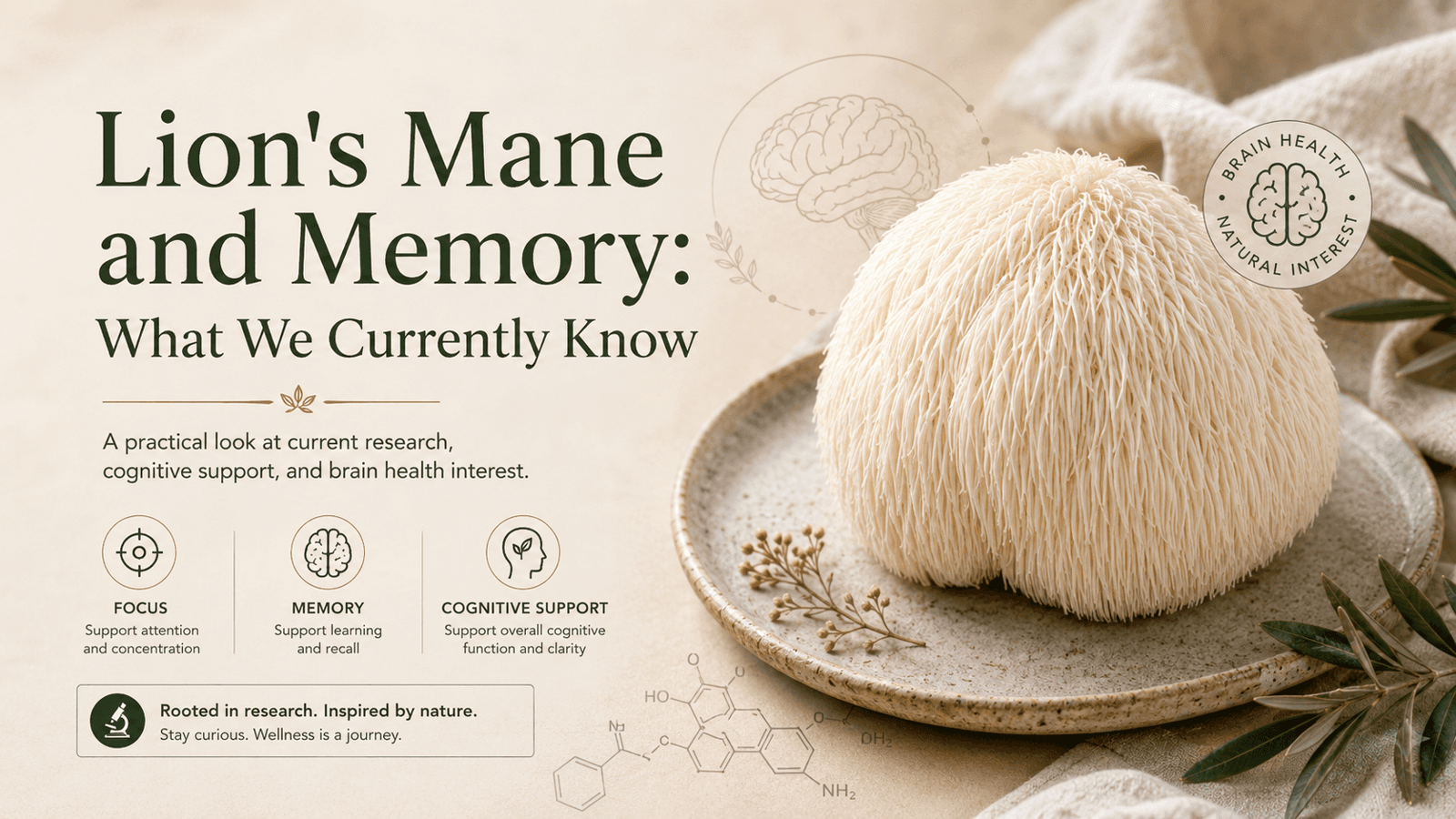
Lion's Mane and Memory: What We Currently Know

SwedeVital Authority Engine™
SwedeVital
In short
Lion's Mane mushroom may support memory by boosting nerve growth factor, but current evidence is limited to lab and small human studies; no definitive health claim exists.
- Lion's Mane shows potential memory benefits in lab and early human studies, but evidence is not yet strong enough for a definitive claim.
Lion's Mane memory claims are everywhere, but the honest summary is narrower than the marketing. Lion's Mane (Hericium erinaceus) is an edible culinary mushroom that has been traditionally used in East Asia and, more recently, studied for its potential role in nerve health and cognition. Laboratory and animal research is genuinely interesting, and a small number of early human trials have looked at memory-related outcomes. But the evidence should be read as may support, not will improve: there is no authorised EU health claim for Lion's Mane and memory, and the strongest results so far come from cells and animals rather than large human studies.
Bottom line: Lion's Mane is a promising, well-tolerated functional mushroom with early evidence around cognition and nerve health. It is a food supplement to be discussed honestly, not a memory cure.
What is Lion's Mane, and why is it linked to memory?
Lion's Mane is a white, shaggy mushroom that grows on hardwood trees and looks a little like a cascade of icicles. It has a long history in traditional food and wellness use across China, Japan and Korea. The modern interest in Lion's Mane and memory comes from a specific biological idea: the mushroom contains compounds — notably hericenones (found mainly in the fruiting body) and erinacines (found mainly in the mycelium) — that have been studied in the laboratory for their effect on nerve growth factor (NGF), a protein involved in the growth, maintenance and repair of neurons.
Because memory depends on healthy, well-connected neurons, researchers have asked a reasonable question: if a natural compound influences NGF pathways in the lab, could it support cognitive function in people? That question is the honest starting point for everything that follows — and it is a question, not a settled answer.
What the research on Lion's Mane memory actually shows
It helps to separate the evidence into tiers, because they carry very different weight. Being clear about this is what separates an authoritative primer from marketing copy. A claim supported only by a petri dish is not the same as one supported by a randomised human trial, and treating them as equal is exactly how a category loses credibility.
Laboratory and animal research
This is where most of the data sits, and it is the most encouraging. In cell and animal studies, Lion's Mane extracts and their isolated compounds have been studied for effects on NGF-related signalling, nerve regeneration and markers linked to learning and memory. Some rodent work has reported better performance on memory-type tasks during supplementation. This research is a legitimate reason to keep studying the mushroom — but findings in cells and rodents do not automatically translate to humans, and doses used in animals cannot be scaled directly to a person.
Human research
Human trials exist, but they are still few, mostly small, and often short. Some studies in adults with mild, age-related cognitive complaints have reported improvements on cognitive testing while participants were taking Lion's Mane, with the effect appearing to fade after supplementation stopped. Other small trials have looked at mood and general wellbeing. The overall picture is promising but preliminary: encouraging signals, limited sample sizes, and a clear need for larger, longer, independently funded studies before anyone can speak in stronger terms.
It is also worth noting what the human research does not yet establish. There is no reliable evidence that Lion's Mane prevents cognitive decline or dementia, no consensus on an optimal dose, and little long-term safety data at high extract concentrations. Those gaps are not a reason to dismiss the mushroom — early-stage fields always look like this — but they are the reason careful language is not merely a legal formality; it is scientifically accurate.
The responsible way to summarise it: research suggests Lion's Mane may support aspects of cognitive function, and it has been studied for memory, but the human evidence is not yet strong enough to promise a specific outcome.
How Lion's Mane is thought to work
The leading hypothesis centres on neurotrophic support — helping the conditions in which neurons grow and stay healthy — rather than acting like a stimulant. That distinction matters for expectations:
- Not a stimulant. Unlike caffeine, Lion's Mane is not associated with an acute jolt of alertness. Any benefit studied is framed as gradual and supportive.
- NGF-related pathways. Hericenones and erinacines have been studied for their influence on nerve growth factor signalling in laboratory models.
- Beta-glucans and the broader profile. Like other functional mushrooms, Lion's Mane contains beta-glucan polysaccharides that are studied for immune and general-wellness support, which is one reason it appears in wider wellness ranges.
Because the proposed mechanism is supportive and cumulative, most study protocols run for weeks, not days — a useful expectation to set for any customer.
Capsules, dual-extract sprays and gummies: does the format matter?
Format is not just a convenience choice; it affects what compounds end up in the product and how it is used. This is where an informed buyer can genuinely differentiate a range.
Fruiting body vs. mycelium
Products may be made from the fruiting body (the visible mushroom) or from mycelium (the root-like network, often grown on grain). Fruiting-body material is generally richer in the compounds most associated with Lion's Mane, while some mycelium products can carry residual grain that dilutes active content. Neither is automatically wrong, but the label should make clear what is inside.
Why "dual-extract" appears on sprays and tinctures
Some of Lion's Mane's studied compounds are water-soluble (such as beta-glucans) while others are better drawn out with alcohol. A dual extraction — hot water plus alcohol — aims to capture both groups, which is why liquid dual-extract sprays are a common format. Capsules suit customers who want a simple daily routine; sprays suit those who want fast, flexible dosing; gummies lower the barrier for people who dislike capsules. SwedeVital's wellness line spans capsules, dual-extract sprays and gummies precisely because buyer and end-consumer preferences differ — the "best" format is the one a customer will actually take consistently.
A label-reading checklist for buyers
If you are choosing a Lion's Mane line to stock or private-label, the label tells you most of what you need. Work through this checklist:
- Part used. Does it specify fruiting body, mycelium, or a blend — and in what proportion?
- Extract vs. powder. Is it a raw powder or a standardised extract? Extracts should state an extraction ratio (e.g. how many kilograms of raw mushroom per kilogram of extract).
- Beta-glucan content. Reputable functional-mushroom suppliers measure beta-glucans specifically, rather than lumping them in with other polysaccharides or starch from grain.
- Third-party testing. Look for independent testing for heavy metals, contaminants and active content — mushrooms can concentrate what is in their growing substrate.
- Dose transparency. The amount per serving should be stated clearly, not hidden inside a proprietary blend.
- Claim compliance. On-pack wording must respect the rules of the market you sell into. In the EU, that means no unauthorised health claims — a well-run supplier will keep language careful for a reason.
Talking about Lion's Mane memory claims without overstating
The fastest way to lose a category's trust is to promise what the evidence cannot support. Regulation aside, over-claiming invites returns, complaints and reputational damage. A durable position on Lion's Mane memory is one that sells the honest story well:
- Do describe Lion's Mane as traditionally used and as a mushroom that has been studied for cognition and nerve health.
- Do use careful, evidence-led language: may support, research suggests, traditionally used for.
- Do set realistic expectations — supportive, gradual, taken consistently over weeks.
- Avoid any wording that implies treatment, prevention or cure of a disease, or a guaranteed improvement in memory.
- Avoid invented statistics, named studies you cannot cite, or borrowed medical language.
Handled this way, the educational story is a stronger sales asset than a hyped one: it builds credibility with informed buyers and lasts under scrutiny.
Who might consider it, and important cautions
Lion's Mane is generally well tolerated in the research to date, and as a culinary mushroom it has a long history of food use. Even so, a responsible primer names the limits clearly:
- It is a food supplement, not a medicine. It should not replace medical advice, diagnosis or treatment.
- Allergy risk. People with a mushroom allergy should avoid it, and anyone can react to a new supplement.
- Special groups should seek advice. Those who are pregnant or breastfeeding, taking prescription medicines, or managing a health condition should speak to a qualified healthcare professional before starting.
- Quality varies widely. Because active content depends heavily on species, part used and processing, a cheap product is not necessarily comparable to a tested, well-characterised one.
The honest takeaway
Lion's Mane sits in a sweet spot for a modern wellness range: a real culinary mushroom with a credible mechanistic story, encouraging early research, and a broad set of formats to suit different customers. What it is not — yet — is a proven memory treatment. Retailers and end-consumers are best served by the same message: Lion's Mane is a well-tolerated functional mushroom that may support cognitive wellbeing, backed by promising but preliminary science, and worth exploring with realistic expectations and a good-quality, transparently labelled product.
Related reading
Frequently asked questions
What is Lion's Mane mushroom?+
Lion's Mane (Hericium erinaceus) is an edible culinary mushroom traditionally used in East Asia, known for its white, shaggy appearance and potential health benefits.
How might Lion's Mane affect memory?+
Its compounds, hericenones and erinacines, have been studied for their ability to stimulate nerve growth factor (NGF) pathways, which support neuron growth and may enhance memory.
Is there strong evidence that Lion's Mane improves memory?+
Most evidence comes from cell and animal studies; human trials are few, small, and short-term, showing promising but preliminary results without a definitive health claim.
What forms of Lion's Mane are available?+
Products come in fruiting-body or mycelium extracts, capsules, dual-extract sprays, and gummies. Fruiting-body extracts are richer in key compounds, while dual-extracts aim to capture both water- and alcohol-soluble components.
Are there safety concerns with Lion's Mane?+
It is generally well-tolerated, but long-term safety data at high extract concentrations are limited, and no reliable evidence exists for preventing cognitive decline or dementia.
See the full SwedeVital range
Every line, every format, and what it takes to stock them — sent to you now, before we open for orders on 1 January 2027.
Written by
SwedeVital Authority Engine™
Last updated
30 August 2026