
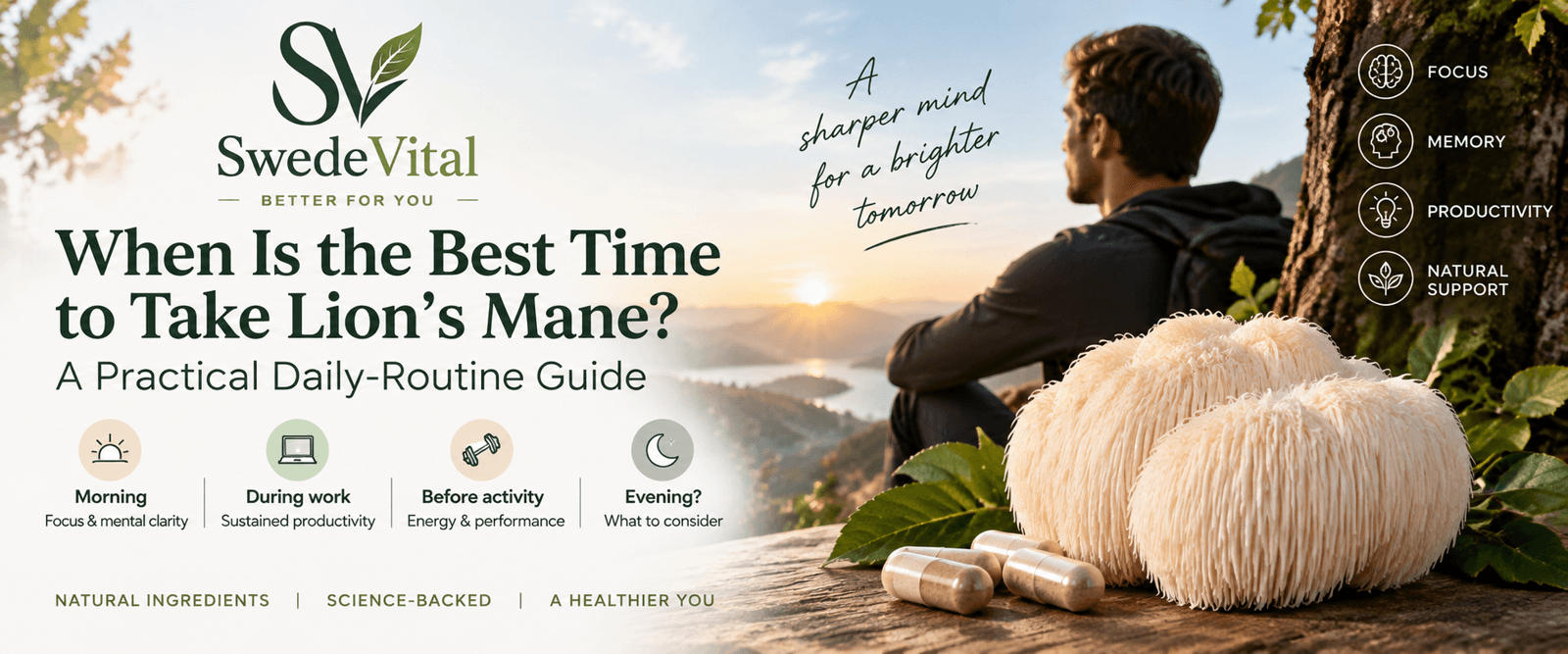
When Is the Best Time to Take Lion's Mane? A Practical Daily-Routine Guide

SwedeVital Authority Engine™
SwedeVital
In short
Take Lion's Mane early in the day—ideally with breakfast or coffee—because consistency is key. Pair it with a small amount of fat for better absorption, and avoid late afternoon if you’re caffeine-sensitive.
- Take Lion's Mane consistently early in the day with breakfast or coffee for best focus and absorption.
When to take Lion's Mane depends on the outcome you are after. Most people take it in the morning or early afternoon, with or shortly after a meal, so that its traditional use for focus and mental clarity lines up with the working day. There is no single "correct" clock time — being consistent across several weeks matters far more than the exact hour — but the format you choose, and whether you pair it with caffeine or an evening wind-down, will decide the best slot for you.
When to Take Lion's Mane: The Short Answer
Lion's Mane (Hericium erinaceus) is a culinary and functional mushroom that has been traditionally used as a daily supplement and studied for its potential role in cognitive support. Because people generally want it working while they think, create and problem-solve, the default guidance is simple: take it early in the day. If your goal is a calm, focused morning, take it with breakfast; if you find any functional mushroom slightly energising, keep it before mid-afternoon so it does not sit too close to bedtime.
That said, Lion's Mane is not a stimulant in the way caffeine is, and research suggests any effects build gradually rather than arriving as a sharp "hit". This is why timing is best understood as a routine question, not a narrow dosage-window question.
When to Take Lion's Mane: Why Consistency Beats Clock-Watching
The most important thing to understand about timing is that daily consistency does more work than any specific minute on the clock. Functional mushrooms are typically taken as part of a sustained routine, and any benefits people report tend to emerge over weeks of regular use rather than from a single well-timed dose.
Practically, that means the "best" time is the one you will actually remember every day. Anchoring the dose to an existing habit — your morning coffee, brushing your teeth, or sitting down at your desk — is far more reliable than aiming for a theoretically perfect window and forgetting half the time.
The best time to take Lion's Mane is the time you can repeat without thinking about it. Habit-stacking beats optimisation.
How long before you notice anything?
Expectations matter here. Some people describe a subtle sense of clarity within the first days, while others notice little until they have taken it consistently for several weeks. Neither experience is unusual, and individual responses genuinely vary. Treat the first four to eight weeks as an honest trial rather than judging a single morning.
Morning Lion's Mane: Aligning With Focus
For most buyers and the end-consumers they serve, the morning is the natural home for Lion's Mane. Taking it alongside breakfast pairs the traditional cognitive-support association with the part of the day that demands the most mental output — meetings, deep work, studying or driving.
A morning routine also has a practical advantage: it removes any doubt about sleep. Even though Lion's Mane is not a classic stimulant, some individuals are sensitive to anything that shifts their mental state, so keeping it to the first half of the day sidesteps the question entirely.
- Best for: knowledge workers, students and anyone who wants their routine to support daytime focus.
- Pair it with: breakfast, or your first coffee if you tolerate both well.
- Watch for: taking it too late in the day if you are caffeine-sensitive.
With or Without Food? Absorption and Comfort
Two things drive the "with or without food" decision: comfort and absorption. Taking Lion's Mane with a meal is the gentler default — a small number of people find any supplement sits poorly on an empty stomach, and food removes that risk.
Absorption is more nuanced and depends on format. Lion's Mane products are usually standardised around compounds such as beta-glucans, and a well-made dual-extract (using both water and alcohol extraction) is designed to make both water-soluble and non-water-soluble compounds available. Some of those compounds are fat-associated, so taking your dose with a meal that contains a little fat is a sensible, low-effort way to support uptake. If you prefer an empty-stomach routine and tolerate it well, that is also fine — comfort should decide.
Evening Lion's Mane and the Caffeine Question
Can you take Lion's Mane at night? For many people, yes. Unlike stimulant nootropics, Lion's Mane is not inherently activating, so an evening dose is reasonable if that is when you will reliably remember it. The caveat is personal sensitivity: if you notice it makes your mind feel more "switched on", simply move it earlier.
The evening is also where stacking comes in. Some people prefer to reserve daytime for focus-oriented options and use the evening for a wind-down routine built around calming ingredients. Reishi (Ganoderma lucidum) is traditionally associated with relaxation, and magnesium is widely used in evening routines, which is why magnesium sleep gummies and Reishi often feature at night while Lion's Mane sits in the morning. This is a matter of routine design, not a rule.
On coffee specifically: taking Lion's Mane with your morning coffee is popular and generally well tolerated. The caffeine provides the alertness; the mushroom is there for the longer, routine-based association with focus. Just remember that the coffee, not the Lion's Mane, is the reason to keep that combination out of the late afternoon.
Match the Timing to the Format
How you take Lion's Mane changes the easiest time to take it. Each format has a natural fit within a daily routine.
Capsules
Capsules are the most routine-friendly format — pre-measured, portable and easy to swallow with breakfast. They suit anyone who wants a fixed daily habit and no fuss. Take them with your morning meal and you are done for the day.
Dual-extract sprays
Sprays are fast, flexible and ideal for people who dislike swallowing capsules or want to dose on the move. Their convenience makes a consistent mid-morning routine easy, and they slot neatly into a desk drawer or bag. Follow the product's stated serving and use the same anchor time each day.
Gummies
Gummies lower the barrier to consistency because they feel like a treat rather than a supplement, which is exactly why they help habit formation. They are a strong fit for consumers who forget capsules. Keep an eye on the total per day and treat the serving guidance as the ceiling, not a target to exceed.
A Practical Daily-Routine Checklist
Use this to settle your own timing in a couple of minutes:
- Define the goal. Daytime focus points to a morning dose; a calmer evening routine may pair better with Reishi or magnesium.
- Pick one anchor. Attach the dose to an existing daily habit so you never have to rely on memory.
- Decide on food. With a meal is the safe, comfortable default, especially for dual extracts; an empty stomach is fine if it agrees with you.
- Mind the caffeine clock. Combining with coffee is fine, but keep the pairing before mid-afternoon.
- Choose the format you will keep up. Capsules for fixed routines, sprays for flexibility, gummies for the forgetful.
- Give it a real trial. Stay consistent for four to eight weeks before you judge the result.
What Retail Buyers Should Take From This
For category managers and private-label partners, timing guidance is a merchandising asset, not just consumer trivia. Shoppers who understand when to take Lion's Mane are more likely to use the product daily, finish the pack and repurchase — the behaviours that drive genuine category velocity.
Format range is part of the answer. Stocking capsules, a dual-extract spray and gummies lets a retailer serve the routine-driven buyer, the on-the-go buyer and the habit-forming buyer from a single shelf. Clear, compliant on-pack and on-site guidance — evidence-led language, honest expectations and no overstated claims — builds the trust that keeps a functional-wellness range credible. SwedeVital's Lion's Mane line spans these formats specifically so partners can match timing advice to the shopper in front of them.
Whatever slot you or your customers land on, the principle holds: pick a realistic time, keep it consistent, and let the routine — not the clock — do the work.
Frequently Asked Questions
Should I take Lion's Mane in the morning or at night?
Morning is the most common choice because Lion's Mane is traditionally used for focus and mental clarity, which suits the working day. Night is fine too if that is when you will remember it, provided you do not personally find it activating. If in doubt, start in the morning.
Can I take Lion's Mane on an empty stomach?
Many people do so comfortably. Taking it with food is the gentler default and, for dual-extract products, a little dietary fat may support uptake. If an empty stomach agrees with you, there is no need to change your routine.
Should I take Lion's Mane with coffee?
Combining Lion's Mane with morning coffee is popular and generally well tolerated. The caffeine supplies the alertness, while the mushroom fits a longer, routine-based focus association. Keep the combination before mid-afternoon so the caffeine does not affect your sleep.
How long does Lion's Mane take to work?
Responses vary. Some people describe subtle clarity within days, while others notice little until they have taken it consistently for several weeks. Treat the first four to eight weeks as a genuine trial rather than judging a single dose.
Can I take Lion's Mane every day?
Lion's Mane is typically used as a daily supplement, and consistent daily use is how most people take it. Follow the serving guidance on your chosen product, and if you have a medical condition or take medication, speak to a healthcare professional first.
Can I take Lion's Mane and Reishi together?
Yes, and many routines split them by time of day — Lion's Mane in the morning for focus, Reishi in the evening for its traditional association with relaxation. Taking them together is also fine; timing them separately is simply a common way to design a routine.
Related reading
- capsule format guide
- spray format guide
- current research on benefits
- functional mushroom overview
- best time to take Reishi
Sources
- The Acute and Chronic Effects of Lion's Mane Mushroom ...
- Lion’s Mane Mushroom (Hericium erinaceus): A Neuroprotective Fungus with Antioxidant, Anti-Inflammatory, and Antimicrobi
- Mushrooms as Nutritional Powerhouses: A Review of Their Bioactive Compounds, Health Benefits, and Value-Added Products
- Subchronic toxicity and genotoxicity studies of Hericium erinaceus β-glucan extract preparation
- Understanding Lion's Mane Mushroom Extracts: Types
Frequently asked questions
When is the best time to take Lion's Mane?+
The best time is early in the day, ideally with breakfast or coffee, because consistency matters more than a specific hour.
Can I take Lion's Mane with or without food?+
Yes—taking it with a small amount of fat in a meal improves absorption, but if you tolerate an empty stomach, that’s fine too.
Does Lion's Mane affect sleep if taken in the evening?+
Lion's Mane is not a stimulant, so an evening dose is fine if you’re not sensitive to a mild mental lift; otherwise, keep it earlier.
Should I pair Lion's Mane with caffeine?+
Pairing with coffee is common and generally well tolerated; the caffeine provides alertness while Lion's Mane supports sustained focus.
How long does it take to notice benefits?+
Benefits may appear within days for some, but most people notice clearer effects after 4–8 weeks of consistent use.
See the full SwedeVital range
Every line, every format, and what it takes to stock them — sent to you now, before we open for orders on 1 January 2027.
Written by
SwedeVital Authority Engine™
Last updated
16 September 2026