
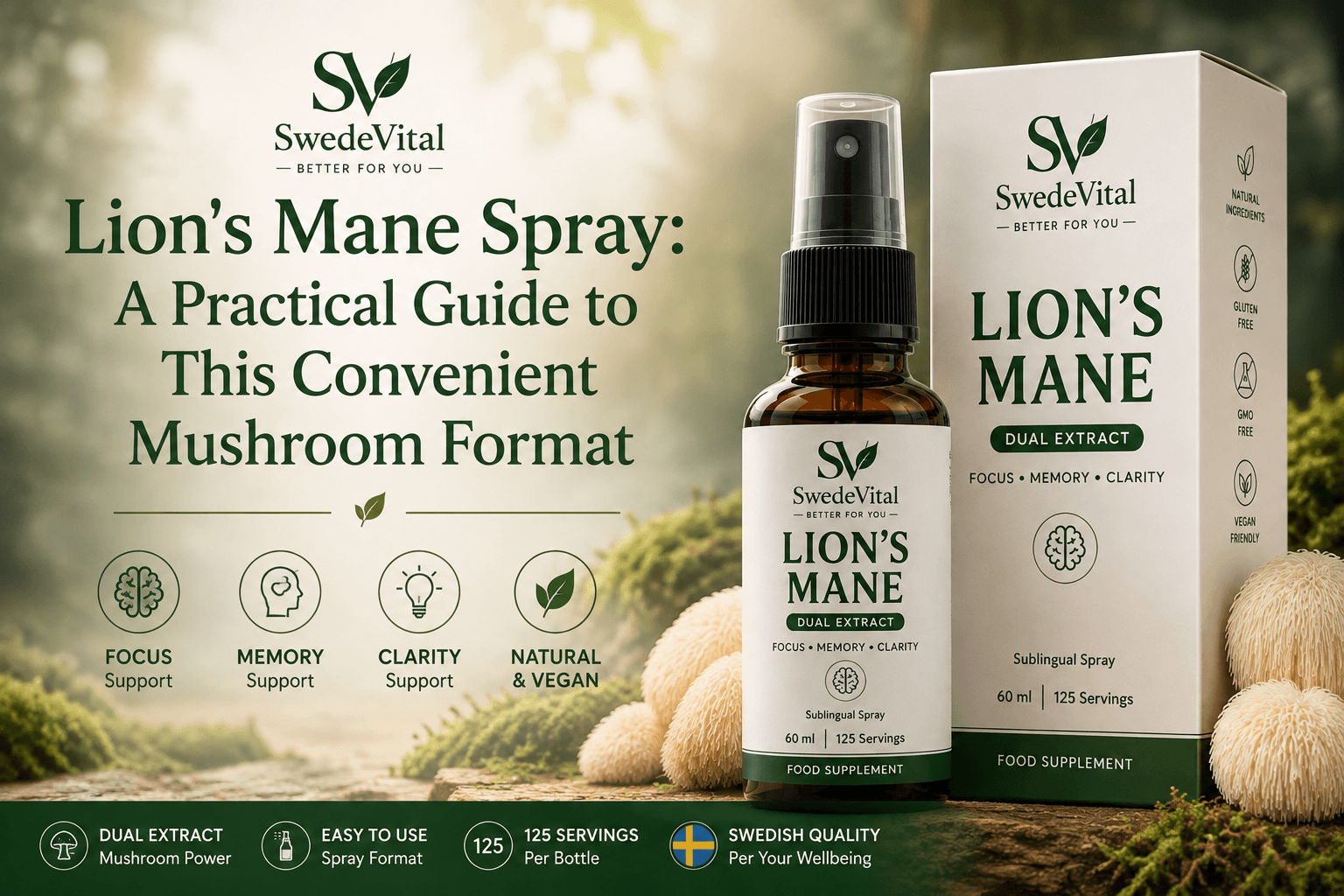
Lion's Mane Spray: A Practical Guide to This Convenient Mushroom Format

SwedeVital Authority Engine™
SwedeVital
In short
A Lion's Mane spray is a liquid extract of Hericium erinaceus delivered in a fine mist, offering quick, measured dosing without swallowing a capsule. It’s convenient, portable, and ideal for those who dislike pills, but its quality depends on the extract’s source, extraction method, and concentration.
- Lion's Mane spray offers quick, convenient dosing of Hericium erinaceus extract, but quality hinges on the extract source, extraction method, and concentration.
A Lion's Mane spray is a concentrated liquid extract of the Hericium erinaceus mushroom delivered as a fine mist you pump into your mouth, so a measured dose is taken quickly and conveniently without swallowing a capsule. It is one of the newer formats in the functional-mushroom category, sitting alongside capsules, powders and gummies. This guide explains what the format actually is, how it compares with the alternatives, what the research does and does not say, and how retail buyers and shoppers can judge quality before they commit.
What is a Lion's Mane spray?
Lion's Mane (Hericium erinaceus) is an edible mushroom with a distinctive white, cascading appearance, long used in East Asian food and traditional practice. A spray takes a concentrated liquid extract of the mushroom and packages it in a small bottle with a pump atomiser. A few pumps under or onto the tongue deliver a serving in seconds, with a spray-and-hold action rather than a swallow.
The appeal is the removal of friction. There is no pill to get down, no powder to measure, no water required. The format travels well, fits in a pocket or handbag, and suits people who dislike capsules or want something they can use discreetly during the day. For a category manager, it is also a visually distinctive shelf product that signals convenience and modernity next to more traditional bottles of capsules, and it opens the category to shoppers who would never pick up a jar of powder.
It is worth being precise about what the format is not. A spray is a delivery method, not a guarantee of potency. The quality of a Lion's Mane spray depends entirely on the extract inside the bottle — the part of the mushroom used, how it was extracted, and how concentrated the liquid is — not on the fact that it is sprayed. A convenient format built on a weak extract is still a weak product.
How a Lion's Mane spray compares with capsules, gummies and powders
No single format is objectively best; each trades one advantage for another. Understanding those trade-offs is the fastest route to the right choice for a given shopper or shelf.
- Spray: fastest and most convenient to use, highly portable, easy to dose in small increments, and often better tolerated by people who dislike swallowing. The limitation is capacity — a small bottle holds a finite amount of extract, so cost-per-serving can be higher than bulk formats.
- Capsules: the most familiar format, with a clearly defined dose per capsule and a long shelf presence. Less convenient on the move, and unsuitable for anyone with pill fatigue or difficulty swallowing.
- Gummies: pleasant to take and good for routine adherence, but they carry added sugars or sweeteners and usually a lower extract load per serving.
- Powders: the most flexible and often the best value per gram, blending into coffee or a smoothie. They demand more effort, accurate measuring, and tolerance for an earthy taste.
A practical way to frame the decision: sprays and gummies win on convenience and adherence, powders win on value and flexibility, and capsules sit in the middle as the dependable default. Many shoppers end up owning more than one format for different moments of the day — a capsule at home, a spray in the bag.
What the research says — and what it does not
Honesty here protects both the shopper and the retailer. Lion's Mane has been studied for its potential effects on cognition, mood and nerve health, and laboratory work has looked at compounds in the mushroom known as hericenones and erinacines. Traditionally, it has been used in East Asian systems as a general tonic.
That said, much of the existing research is early-stage, small, or conducted in laboratory and animal models rather than large human trials. Research suggests possible benefits and points to avenues worth exploring, but it does not establish the mushroom as a treatment for any medical condition. Under EU food-supplement rules, no authorised health claim currently permits a supplement to state that it treats, prevents or cures disease.
The responsible position is simple: describe Lion's Mane as traditionally used and as an ingredient studied for cognitive and nervous-system support, and never promise a defined outcome. Anyone with a health condition, who is pregnant or breastfeeding, or who takes medication should speak to a qualified professional before use.
For buyers, this matters commercially as well as ethically. Products and listings that make hard medical claims are a regulatory and reputational risk. Evidence-led, non-committal language is both more defensible and, increasingly, more trusted by the informed consumers who now read labels closely and notice overreach.
How to read the label
The label is where a quality extract separates itself from a weak one. A few specifics tell you most of what you need to know, whatever the format on the outside.
Fruiting body versus mycelium
Extracts can be made from the fruiting body — the visible mushroom — or from mycelium, the root-like network, which is often grown on a grain substrate. Fruiting-body extracts are generally regarded as richer in the compounds most associated with Lion's Mane, whereas mycelium-on-grain products can carry residual starch. A transparent label states clearly which is used.
Dual extraction
Some compounds in Lion's Mane are water-soluble and others are better drawn out with alcohol. A dual extract uses both water and alcohol to capture a fuller spectrum. For a liquid format, dual extraction is a meaningful quality signal and one of the first things to look for.
Concentration and beta-glucans
Look for the extract ratio (for example a stated concentration) and, where available, a figure for beta-glucans — a class of polysaccharides used as a rough marker of extract quality. Be cautious of labels that highlight generic "polysaccharides", which can include starch from a grain substrate rather than the mushroom itself.
Third-party testing and clean formulation
Reputable manufacturers test for contaminants such as heavy metals and can supply certificates of analysis. A clean formulation keeps its ingredient list short: the extract, a carrier, and minimal preservatives, without unnecessary sweeteners or fillers.
How to use it day to day
Using a spray is straightforward, but a little technique improves the experience. Shake the bottle, then deliver the number of pumps stated on the label into the mouth, ideally under the tongue, and hold briefly before swallowing. Follow the manufacturer's serving guidance rather than improvising a dose.
Timing is a matter of preference. Some people use Lion's Mane in the morning as part of a focus routine; because it is not a stimulant, it can equally be used later in the day without disturbing sleep. Consistency tends to matter more than the exact hour — functional mushrooms are generally regarded as something to take steadily over weeks rather than as an instant fix. As with any supplement, begin conservatively, see how you respond, and keep it well away from children.
Storage, shelf life and merchandising
Because a spray is a liquid, storage deserves a moment of attention. Keep the bottle tightly closed, out of direct sunlight and away from heat, and observe the best-before date and any post-opening window the manufacturer specifies. Liquids can be more sensitive than dry capsules to temperature and light, so a cool, dark cupboard is ideal.
On the shelf, the compact bottle is an advantage: it merchandises well at the till as an impulse or trial purchase, pairs naturally with capsules of the same active for cross-sell, and photographs cleanly for e-commerce. For buyers building a functional-mushroom set, offering one active in several formats lets the same shopper return for the version that fits each occasion.
A buyer's quality checklist
For retail buyers and private-label partners assessing a Lion's Mane spray, the following checklist separates a credible product from a marketing exercise:
- Source clarity: does the label specify fruiting body, and name Hericium erinaceus?
- Extraction method: is it a dual (water and alcohol) extract, with the ratio or concentration disclosed?
- Active markers: are beta-glucans reported rather than vague "polysaccharides"?
- Testing: is there third-party analysis for contaminants, with certificates available on request?
- Clean label: is the ingredient list short, with no needless sweeteners or fillers?
- Compliant claims: is the language evidence-led and non-committal, free of disease claims?
- Dosing transparency: is the amount of extract per pump, and per bottle, clearly stated so cost-per-serving can be calculated?
- Supply reliability: can the manufacturer demonstrate consistent batches and documentation across the range?
SwedeVital's functional-wellness line covers Lion's Mane and other mushrooms — including Reishi, Cordyceps and Turkey Tail — across capsule, dual-extract spray and gummy formats, which lets a retailer offer the same active ingredient in the format each customer prefers rather than betting on one.
Who this format suits
A spray is a strong fit for people who value convenience above all: commuters, travellers, capsule-averse shoppers, and anyone building a daily routine they want to keep simple. It also works well as an entry product — a low-commitment way to try Lion's Mane before moving to a larger powder or capsule pack.
It is a weaker fit for high-volume users focused on cost-per-gram, who are usually better served by powders, and for anyone who specifically wants a large, fixed capsule dose. Framing the spray honestly against those alternatives builds trust and reduces returns. The goal is not to declare a winner but to match format to person — and a well-made Lion's Mane spray earns its place by making a considered mushroom routine genuinely easy to keep.
Related reading
Frequently asked questions
What is a Lion's Mane spray?+
It is a liquid extract of the Hericium erinaceus mushroom delivered as a fine mist, allowing quick, measured dosing without swallowing a capsule.
How does a spray compare to capsules, gummies, and powders?+
Sprays are fastest and most convenient but have limited capacity; capsules offer familiar dosing; gummies are pleasant but lower extract load; powders provide best value and flexibility but require measuring.
What should I look for on the label to ensure quality?+
Check if the extract is from fruiting body or mycelium, look for dual extraction (water + alcohol), verify concentration and beta‑glucan content, and confirm third‑party testing.
Can Lion's Mane spray treat medical conditions?+
No, current research is early‑stage and not approved for medical claims; it is traditionally used as a tonic and studied for cognitive and nervous‑system support.
Is it safe for everyone to use?+
People with health conditions, pregnant or breastfeeding, or on medication should consult a professional before use.
See the full SwedeVital range
Every line, every format, and what it takes to stock them — sent to you now, before we open for orders on 1 January 2027.
Written by
SwedeVital Authority Engine™
Last updated
31 August 2026