
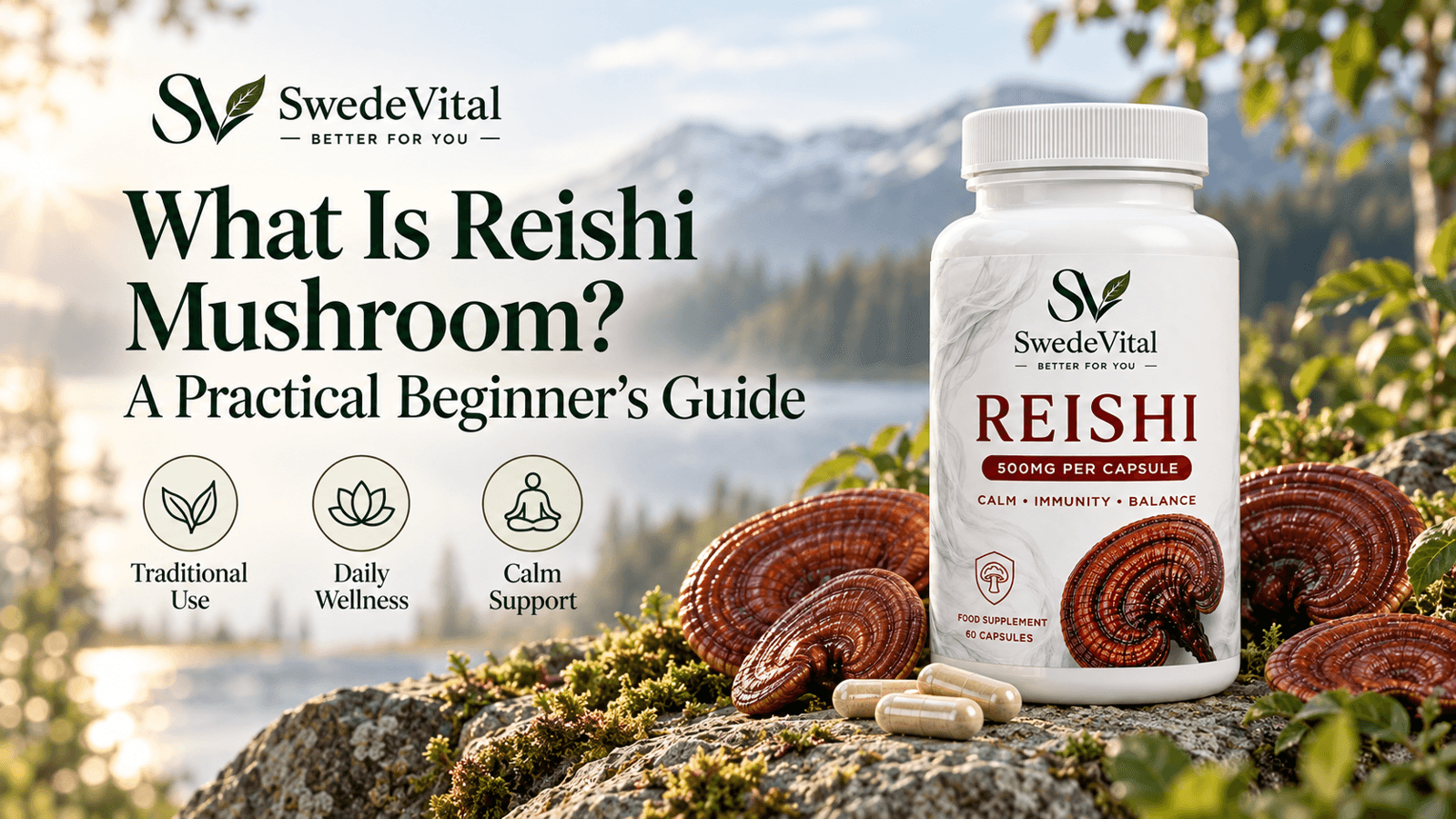
What Is Reishi Mushroom? A Practical Beginner's Guide

SwedeVital Authority Engine™
SwedeVital
In short
Reishi mushroom (Ganoderma lucidum) is a medicinal fungus used for its calming, immune‑supporting, and antioxidant properties, typically extracted into supplements rather than eaten.
- Reishi mushroom is a medicinal fungus valued for its calming and immune‑supporting effects, best consumed as a dual‑extraction supplement.
What is Reishi mushroom? Reishi (Ganoderma lucidum) is a woody, fan-shaped medicinal mushroom that has been used in East Asian herbal traditions for more than two thousand years, where it is known as lingzhi in China and reishi in Japan. Today it is one of the most sought-after functional-wellness mushrooms, taken as capsules, dual-extract sprays, gummies and powders rather than eaten as food. This guide explains what Reishi actually is, what the research suggests it may do, how the different forms compare, and how to judge quality before you buy or stock it.
Reishi sits at the premium, considered end of the wellness aisle. Shoppers rarely pick it up on impulse the way they might a protein bar; they research it, compare formats and read labels. For retail buyers and the customers they serve, understanding the fundamentals below is the difference between choosing a credible extract and paying for an expensive placebo.
What is Reishi mushroom, exactly?
Reishi is the common name for several closely related species in the Ganoderma genus, of which Ganoderma lucidum and the closely related red Reishi are the best known. It grows as a bracket or shelf fungus on hardwood trees, and in its dried form it is hard, corky and intensely bitter. That bitterness and toughness are the reason Reishi is almost never used as a culinary mushroom, unlike shiitake or the meaty Lion's Mane. Instead, its active compounds are drawn out through extraction and concentrated into supplements.
Historically, Reishi held an unusually high status. In classical Chinese herbal texts it was grouped among the superior tonics and associated with calm, resilience and vitality, and it appears frequently in traditional art as a symbol of wellbeing and longevity. It is important to read that heritage for what it is: a long record of traditional use, not a modern clinical guarantee. Reishi is regulated in the European Union as a food supplement, not a medicine, and that framing should shape every expectation around it.
What is Reishi mushroom used for? Benefits and the evidence
Search interest in Reishi mushroom benefits is high, and it helps to separate traditional use from what current science can and cannot say. In East Asian tradition, Reishi has been used as a calming shen tonic — an ingredient associated with settling the mind, supporting restful sleep and helping the body cope with stress. That is why it is often marketed today as an adaptogen and an evening or wind-down supplement rather than a stimulant.
On the research side, the picture is genuinely interesting but still developing, and honesty matters here more than enthusiasm. Reishi has been studied for its polysaccharides, particularly beta-glucans, which research suggests may interact with the immune system, and for its antioxidant activity in laboratory settings. Early and preliminary studies have also explored its role in relation to fatigue, sleep quality and general wellbeing. What responsible language looks like is this:
- Reishi has traditionally been used to support calm and restful sleep.
- Its compounds have been studied for immune-modulating and antioxidant activity.
- Research suggests it may support the body's response to everyday stress.
Equally important is what cannot be claimed. Reishi should never be described as a treatment, cure or prevention for any disease, and no supplement can promise a guaranteed medical outcome. Much of the existing evidence comes from laboratory or small-scale studies, and larger, high-quality human trials are still limited. A brand or retailer that leans on measured, evidence-led language builds far more trust than one making bold promises — and it avoids the regulatory exposure that overstated health claims create in the EU.
Inside Reishi: triterpenes, beta-glucans and why extraction matters
To judge a Reishi product you need to know what it is actually delivering. Reishi's reputation rests on two main families of compounds, and they behave very differently, which has real consequences for how a good extract is made.
- Triterpenes (including the ganoderic acids) are the bitter, resinous compounds most distinctive to Reishi. They are largely alcohol-soluble, meaning they are best extracted with alcohol rather than water.
- Beta-glucans and other polysaccharides are the compounds most associated with immune-related research. They are water-soluble and are drawn out through hot-water extraction.
This is why the phrase dual extraction matters. Because the two compound groups dissolve in different solvents, a hot-water-only tea captures the polysaccharides but leaves most of the triterpenes behind, while an alcohol-only tincture does the reverse. A dual-extract process uses both water and alcohol to capture a fuller spectrum of Reishi's compounds. When you compare products, a specified beta-glucan content and a genuine dual-extraction method are strong signals of a serious extract rather than a token dusting of mushroom powder.
The forms of Reishi: capsules, sprays, gummies and powders
Reishi is sold in several formats, and the right one depends on the user's priorities around convenience, taste, dose control and how quickly they want to build it into a routine. None is inherently superior; each involves a trade-off.
Capsules
Capsules are the most familiar format: precise, portable and taste-free. They suit people who want a fixed daily amount without dealing with Reishi's natural bitterness, and they travel well. The trade-off is that dosing is fixed to the capsule size and they act no faster than any other swallowed supplement.
Dual-extract sprays
Liquid sprays deliver a concentrated extract in a fast, flexible way — a few sprays under the tongue or into a drink. They allow small adjustments to the amount taken and are convenient for people who dislike swallowing capsules. The trade-off is that liquid extracts carry more of Reishi's characteristic taste, which some users find bracing.
Gummies
Gummies trade some potency for palatability and habit-forming ease. They are the friendliest entry point for newcomers and the most likely to be taken consistently, which matters because adaptogens are generally used over weeks, not as a one-off. The trade-off is a lower and less flexible extract dose per serving, and added ingredients such as sweeteners to mask bitterness.
Powders and teas
Loose extract powders can be stirred into coffee, cacao or broths and offer flexible dosing at often lower cost per gram. They demand more effort and a tolerance for flavour, and quality varies widely, so the source and extraction method matter even more here.
How to choose a quality Reishi extract: a checklist
Reishi is a category where price and quality diverge sharply, and the label often reveals more than the marketing. Whether you are a shopper or a buyer assessing a supplier, this checklist surfaces most of the difference quickly:
- Fruiting body vs mycelium. Extracts from the Reishi fruiting body (the mushroom itself) are generally richer in the studied compounds than mycelium grown on grain, which can be diluted by residual starch. Look for clarity on which is used.
- Extraction method. Prefer a stated dual extraction (water and alcohol) so you capture both beta-glucans and triterpenes, not just one.
- Beta-glucan content. A specified beta-glucan percentage — rather than a vague "polysaccharide" figure, which can be inflated by starch — signals a transparent, well-characterised extract.
- Third-party testing. Reishi is a concentrated product grown on wood, so independent testing for heavy metals, contaminants and potency is a meaningful quality marker.
- Species and origin transparency. A trustworthy label names the species and is open about sourcing rather than hiding behind a generic "mushroom blend".
- Honest claims. Evidence-led, non-committal language is a quality signal in itself; guaranteed-outcome promises are a red flag for both compliance and credibility.
With Reishi, the label tells the story: fruiting body, dual extraction, a stated beta-glucan level and third-party testing separate a serious extract from an expensive powder.
How to take Reishi, and when to be cautious
Because Reishi is traditionally associated with calm rather than stimulation, many people take it in the evening or as part of a wind-down routine, though it can be taken at any time of day. Like most adaptogens, it is generally used consistently over a period of weeks rather than expected to work instantly; the experience is one of gradual, subtle support rather than a sudden effect. Always follow the dosage on the product you choose, since concentration varies significantly between formats and brands.
Sensible caution applies. Reishi is not a substitute for medical care, and certain groups should speak to a qualified healthcare professional before use — including anyone who is pregnant or breastfeeding, taking anticoagulant or blood-pressure medication, managing a health condition, or preparing for surgery. Some people experience mild digestive upset when starting. None of this is cause for alarm; it is simply the responsible way to approach any concentrated botanical supplement.
Reishi is one of a small group of functional mushrooms — alongside Lion's Mane, Cordyceps and Turkey Tail — that anchor the modern wellness aisle, each with its own traditional associations and research focus. For retailers building a credible functional-wellness range, or shoppers deciding where to start, Reishi's long heritage and its calming, everyday-wellbeing positioning make it a natural cornerstone. Ranges such as SwedeVital's, which offer Reishi as capsules, dual-extract sprays and gummies, exist precisely so that different customers can find the format they will actually keep using — because with adaptogens, consistency is what turns an interesting purchase into a genuine habit.
Related reading
- capsule quality signals
- Reishi spray format
- Reishi gummies vs spray vs capsules
- Choosing high‑quality Reishi
- Functional mushrooms guide
Sources
- Evaluation of Immune Modulation by β-1,3; 1,6 D-Glucan ...
- Lingzhi (mushroom) - Wikipedia
- EU Novel Food Catalogue: Mushroom Status by Species (2026)
- A double-blind, randomised, placebo-controlled trial of Ganoderma lucidum for the treatment of cardiovascular risk facto
- Reishi Mushroom | Memorial Sloan Kettering Cancer ...
Frequently asked questions
What is Reishi mushroom used for?+
Reishi is traditionally used to support calm, restful sleep and to help the body cope with stress. Research suggests its beta‑glucans may modulate the immune system and its triterpenes have antioxidant activity.
How does dual extraction benefit Reishi supplements?+
Dual extraction uses both water and alcohol to capture both water‑soluble beta‑glucans and alcohol‑soluble triterpenes, providing a fuller spectrum of Reishi’s active compounds.
What forms of Reishi are available?+
Reishi is sold as capsules, dual‑extract sprays, gummies, and powders. Each format offers different convenience, taste, and dosing flexibility.
Can Reishi cure or treat diseases?+
No. Reishi should not be described as a treatment, cure, or prevention for any disease. Claims must be evidence‑based and not overstated.
What should I look for when buying Reishi?+
Look for products that specify beta‑glucan content and use a genuine dual‑extraction method. This indicates a serious, quality extract rather than a low‑quality powder.
See the full SwedeVital range
Every line, every format, and what it takes to stock them — sent to you now, before we open for orders on 1 January 2027.
Written by
SwedeVital Authority Engine™
Last updated
27 September 2026